
Permanent magnet (PM) rotors are very successfully used for pumping and stirring of liquid metals [1] due to fact that they are non-invasive and do not loose energy in windings as it is in 3-phase inductors classically used for such tasks. Though in practice PM systems are being used only in metals that are relatively cool like Li, Na, Hg or some eutectics like In-Ga-Sn due to fact that PM produce relatively high fields only at small distances, but hot-liquid metals like Iron or Aluminium requires significant thermal isolation layer and therefore magnets can be put only at significant distance from metal making them ineffective. So there was set task to optimize PM configuration to achieve higher fields at further distances. Considering the optimization task regarding the most efficient stirring and/or pumping efficiency it was proposed that, if the distance of the liquid metal region from the surface of the magnetic rotor is not very small, a single cylindrical permanent magnet may turn out the best option [2] in respect to traditionally used multipolar designs (Fig.1.).
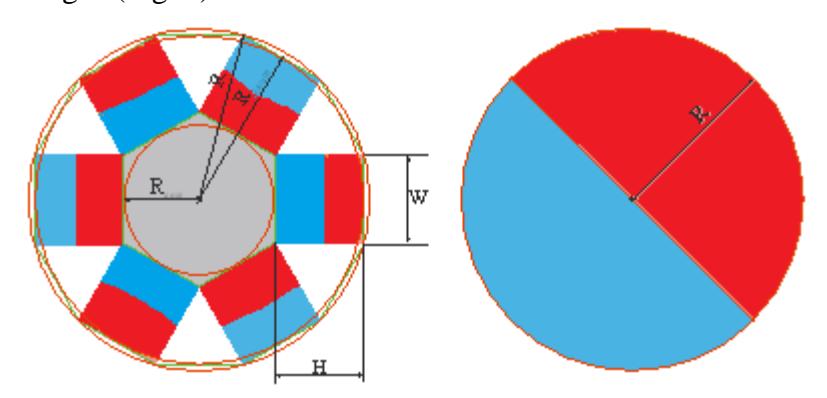
Rotating magnetic cylinder produces alternating magnetic flux in the surrounding space and induces vortical electrical field. Induced current in conducting media, interacting with the magnetic field, results in electromagnetic force proportional to a square of magnetic field induction and first order of the frequency. It is obvious that a single cylindrical PM, a magnetic dipole, would produce maximum of induction comparing to any other rotor with higher number of magnetic poles. Therefore a small scale model was built to test experimentally the feasibility of such a stirrer for practical tasks of metallurgy.
Modern rare-earth permanent magnets tend to ideal when magnetization is nearly uniform all over the volume and relative magnetic permeability is nearing 1. Therefore, two dimensional magnetic field of a cylindrical magnet with remanence $B_r$ transverse to the axis of a cylinder, and radial extent R >> W (W - axial length of the magnet) at a distance L from the axis of the magnet may be given by a simple expressions (1) in polar coordinates
$$B_{rad} = \frac{B_r}{2} \cdot \left(\frac{R}{L}\right)^2 \cdot \cos(\omega \cdot t)$$
$$B_{\varphi} = \frac{B_r}{2} \cdot \left(\frac{R}{L}\right)^2 \cdot \sin(\omega \cdot t)\tag{1}$$
These simple expressions allowed us to calculate also analytically output parameters of such system. As these results were close to ones obtained experimentally, it was possible also to compare results with multipolar rotors and calculate if similar systems could be used in real metallurgical applications.
After first experimental tests it seems that a cylindrical magnetic dipole rotor may be a promising option to consider for practical tasks in metallurgy for stirring or even transporting molten metal, moreover when high temperature and/or erosive action of the melt require thick refractory wall thickness of the melt containing enclosure. There were also proposed more complex systems with two, three and more rotating PM cylinders in series coupled magnetically or mechanically which gives possibility to create more powerful systems and systems that create completely different flow patterns, which are more perspective rather for stirring than metal transport.