
Cloud chamber is a device, invented by C. T. R. Wilson in the beginning of 20th century, used for detecting paths of charged particles and other ionising radiation [1]. It can be called the cornerstone of the experimental particle physics, because it gave discoveries of a positron and muon – first discovered elementary particles, which are not, by direct means, a part of an atom.
The operating principle of the cloud chamber is based on the nucleation (formation of droplets) of supersaturated (more than it should be under given conditions) vapour around the condensation nuclei – when a charged particle passes through vapour, it ionises vapour atoms alongside its path and the ionised atoms act as condensation nuclei, forming a cloud.
The original cloud chamber, as developed by C. T. R. Wilson, used the process of adiabatic expansion to form supersaturated vapour, but because of discontinuous operation the active time of track formation was less than a second [2]. However Patrick Blackett partly solved it by making rapid expansions a few times per second. Another great developer of the cloud chamber was Alexander Langsdorf, who developed diffusion cloud chamber – a continuously sensible cloud chamber in 1939 [3].
Since 20th century technologies have greatly advanced and more sophisticated particle detectors were created, pushing cloud chambers out of the research field. Currently, semiconductor devices are being used to detect paths of elementary particles. However, due to its simple construction, diffusion cloud chambers are still being built. Their complexity varies from simple home made to enough technically equipped to produce fairly accurate measurements. Since this device has such a straightforward display of subatomic particles, the goal of this research is to share the experience of building and testing diffusion cloud chamber.
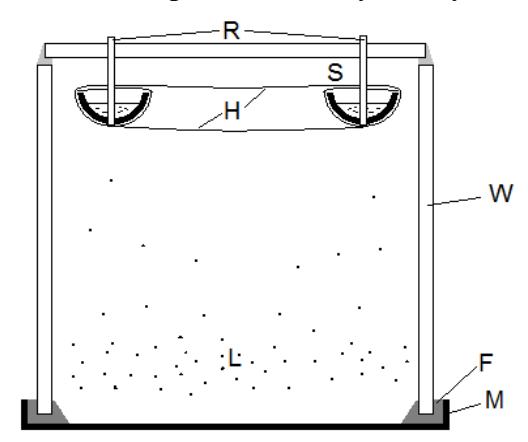
The particular diffusion cloud chamber, which was used in experiment, is shown schematically in Fig. 1. Container walls (and top) [W] are made out of 125x125x4mm Plexiglas plates. The bottom is 1mm thick steel plate [M] with folded sides. It was painted black, for better contrast of particle tracks. Walls, top and bottom of the chamber have been fixed together using adhesive sealant [F]. The heating wire [H] was wrapped on two plastic trays [S], which were connected to the top of the chamber using metal rods [R].
During the experiment, trays were filled with pure isopropanol (2-propanol) and the heating was turned on by supplying power to the metal rods. When the cloud chamber is saturated with isopropanol vapour the bottom is then cooled to temperature, les than 200K.
Bright white tangential light is applied to the side of the cloud chamber to make the isopropanol mist visible. After 2 min. of cooling, a layer of supersaturated vapour [L] starts to form at 2-3 cm above the bottom of the chamber. Obscured trails can be observed at this time, however, it takes approximately 10-15 minutes until the supersaturated layer fully forms.
Observed natural background radiation consisted mainly of beta particles, which formed thin (less than 1mm) and relatively long (5-10cm) tracks. However, due to greatly varying energy (in range from keV to MeV), beta particle tracks had different forms, from short and curly (due to interaction with vapour molecules) to straight long lines, although less energetic beta particles were more common. Another common radiation was alpha particles, occurring a few times per minute, compared to several tracks of beta radiation every second. Alpha particle tracks are thick (5-10mm), short (up to 4cm) straight lines. Besides of common tracks, several rare events were also observed. High energy cosmic alpha particles had enough energy to pass through the whole cloud chamber (12cm). High energy alpha particle collision with a molecule was also observed. There were other cosmic ray events, which are not discussed here.
It is important to discuss problems, which occurred during the experiments. The most common problem is setting up the right heating and cooling. Underheating and incorrect cooling resulted in depletion of the supersaturated layer, while overheating caused vapour condensation on the walls. Optimal bottom temperature was found out to be 200-220K. Other problems were cracking of Plexiglas, sealant and paint detaching due to chemical and physical reactions to isopropanol and very low temperatures.