
Optical properties of the diffraction grating based laser beam splitters depend on the chosen materials, linear dimensions and profile of the grating. Appropriate set of grating parameters allows controlling intensity and spatial distribution of diffraction spectra. Diffraction optical elements are most efficient only in a narrow wavelength range and are designed and manufactured for every application individually. In this work we present experimental results and simulations of optical properties of visible light diffraction grating based beam splitters.
Diffraction gratings that were used as beam splitters were fabricated in 15x15 mm2 fused quartz substrates employing optical-contact lithography and plasma chemical etching, that was performed in PK-2430PD unit with mixture of CF4 (80 %) and O2 (20 %) gases. The depth of structures was controlled by changing etching duration (18 - 40 min) and it was measured by an atomic force microscope NT-206. Linear dimensions of the formed structures were measured by a scanning electron microscope (SEM) FEI Quanta 200 FEG. The optical properties were evaluated by measuring white light reflection and transmission spectroscopy (spectrometer AvaSpec-2048). More experimental details can be found elsewhere [1]. Numerical simulations of diffraction efficiencies (transmission and reflection spectra) were performed with a standard software ("PCGrate" based on the integral equation method) and additionally calculated using analytical model of a rectangular profile phase diffraction grating, which ridge (a) and groove (b) are of equal width.
The fabricated phase diffraction gratings of greater depth (etching time 40min) revealed a disagreement between the experimental and simulated diffraction efficiencies. From the obtained SEM micrographs it was found that the profile of diffraction grating is sine trapezoidal (Fig.1.). The change of the initial rectangular profile could be addresses to the anisotropy of plasma chemical etching. Depth of the fabricated structures was estimated from the white light transmission spectroscopy measurements using the (1) equation [2]:
$$h = \frac{(2k+1)\lambda}{2 \left(\frac{n_2^2}{\sqrt{n_2^2 - n_1^2 \sin^2 \alpha}} - \frac{n_1}{\cos \alpha}\right)}\tag{1}$$where $\alpha$ is the angle of incidence, $n_1$, $n_2$ – refractive indexes of the incidence media and diffraction grating respectively, $k = 0, 1, 2...$

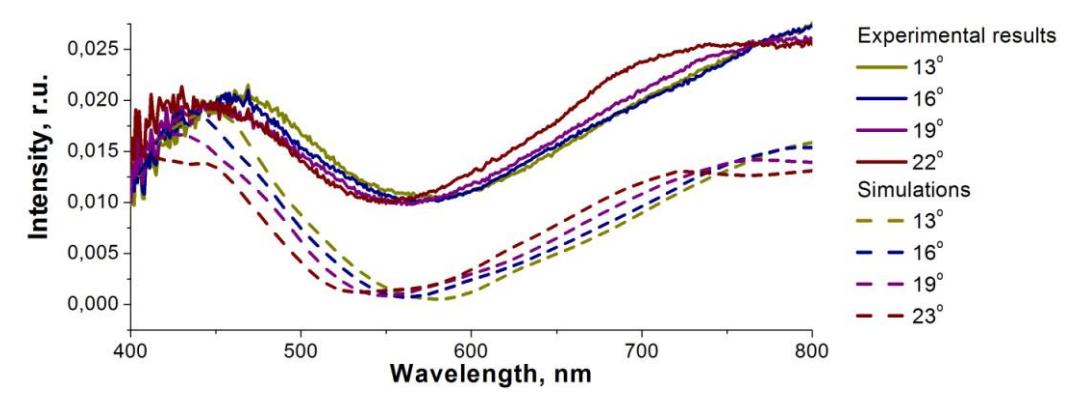
Numerical diffraction efficiency (reflection) simulations obtained with the "PCGrate" software using sine trapezoidal grating profile are in good correlation with the experimental results (Fig. 2.).
We have shown that our produced beam splitters demonstrate high diffraction efficiencies (73.4%, $\lambda$=405nm);
The disagreement between experimental and theoretical diffraction efficiencies of the fabricated beam splitters was explained by the anisotropy of plasma chemical etching, which causes sine trapezoidal profile of the grating.
We have demonstrated that depth of the grooves can be evaluated from the white light transmission spectroscopy measurements.