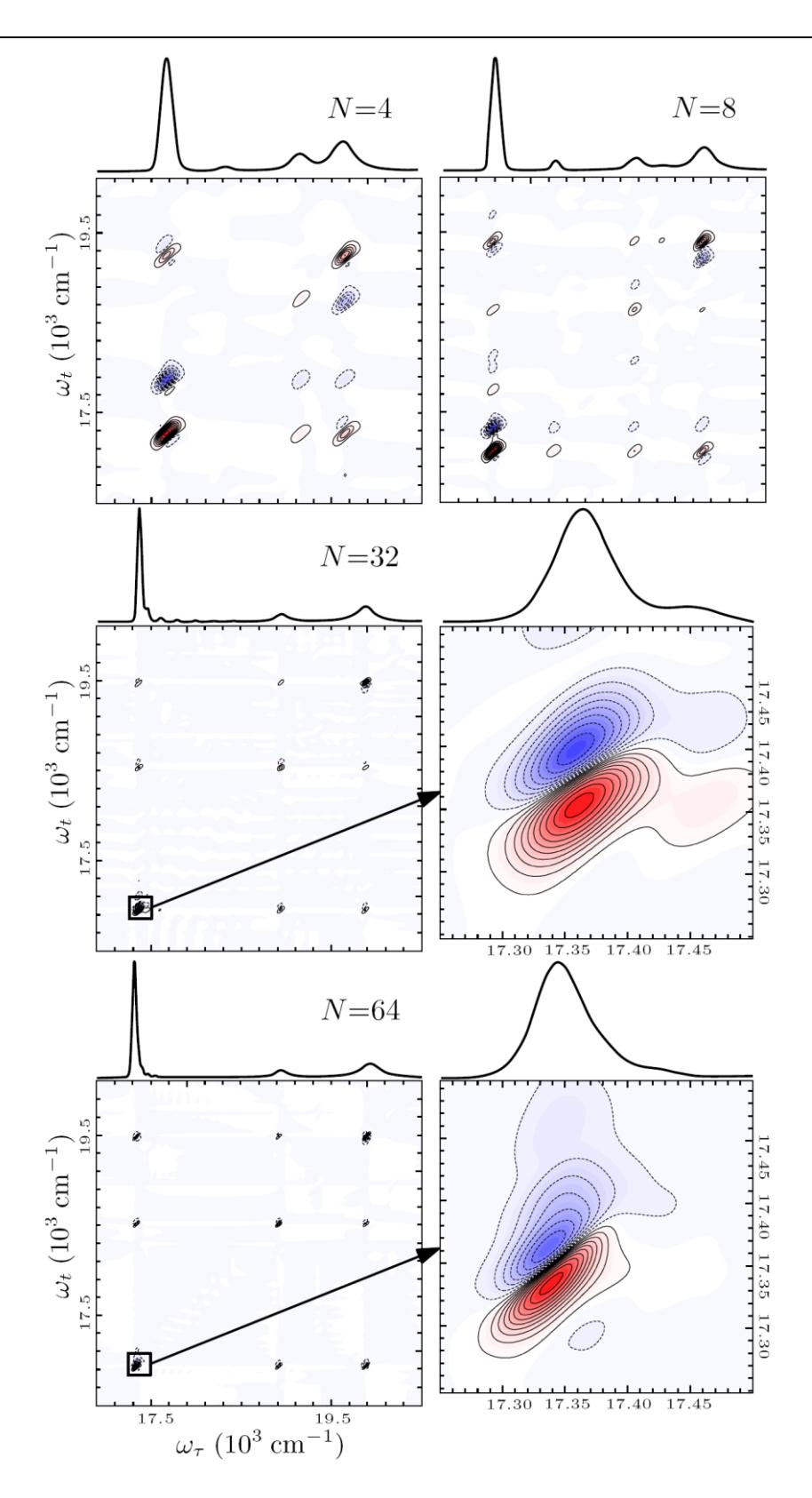
Time-resolved two-dimensional photon-echo (2D PE) spectra of excitonically coupled dimer as well as linear J-aggregates containing four molecules per unit cell is theoretically considered. Analysis of a single unit cell and the full-sized J-aggregate is carried out. Spectral features of a single unit cell are sorted out by assigning them to specific double-sided Feynman diagrams. Two different approaches of disorder are employed, the resulting differences in the spectra are discussed and the conditions for their utilization are described. Special attention is paid to quantum coherence dynamics of a single unit cell and the full-sized J-aggregate. Possibilities of probing quantum coherences as well as performing quantum control by two-colour 2D PE spectroscopy are discussed.
To simulate the third-order polarization for 2D spectra calculations, we use the system response function theory considering the field-matter interaction perturbatively in terms of the time-dependent density operator [1-3]. The third-order polarization, detected at the photon-echo direction, is obtained as a triple convolution of the system response function and the sample-exciting electric field:
$$P_{PE}^{(3)}(T,T,t) = \int_0^{\infty} dt_3 \int_0^{\infty} dt_2 \int_0^{\infty} dt_1 S^{(3)}(t_3, t_2, t_1) \times E(\vec{r}, t - t_3)E(\vec{r}, t - t_3 - t_2) E(\vec{r}, t - t_3 - t_2 - t_1) \tag{1}$$The total system response is resolved as a number of oscillating patterns corresponding to Liouville space pathways. Using a second-order cumulant expansion technique, the shapes of spectral elements of the oscillating terms in frequency domain are determined by summing up the time-dependent lineshape functions, that are calculated using the classically-defined spectral density function of the bath fluctuations.
Time-resolved two-dimensional photon-echo spectra of linear J-aggregates containing four molecules per unit cell - a model system for a concentrated water solution of the pseudoisocyanine dye - is theoretically considered. The superradiant J-band spectrum is a superposition of a few different pathways. The simulated quantum coherence beats are dependent on the model of disorder.