
Ionizing radiation detectors are in harsh environment during experiments in Large Hadron Collider (LHC). So they degrade because of it. To develop semiconductor material and create detectors with improved properties, such as high speed and high radiation hardness, the collaboration program RD50 was started by CERN. Silicon is still the best choice for that purpose. It is believed, that new detectors with better properties, achieved by modification of silicon, will replace the old ones in LHC after 5 years of experiments.
One of the aims of our work was to upgrade the photoelectrical spectroscopy equipment, in order to investigate defect properties and their variation upon irradiation by different fluencies of ionizing radiation. Moreover, to observe photoconductivity quenching effect, two-monochromator system was implemented with automatic wavelength and light intensity control.
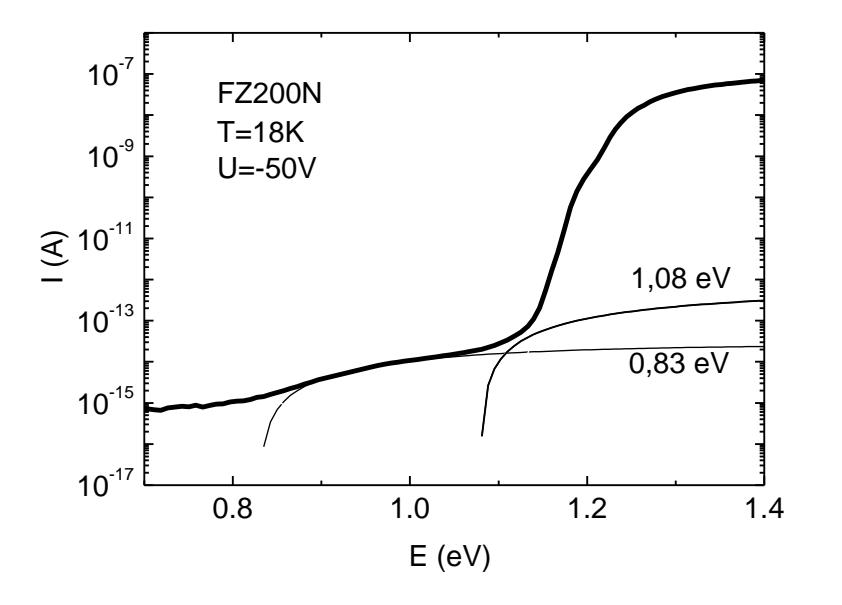
The main purpose of our research was evaluation of activation energies of local levels in the nonirradiated silicon detectors. The obtained photoconductivity spectra were modeled numerically by Lucovsky model [1] (Fig.1). The following values of optical activation energies of deep centers were determined: 0,83 eV and 1,08 eV.
In order to identify shallower levels which could not be observed using photoionisation spectroscopy, the thermal stimulated currents method was applied. Activation energies of these levels are as folows: n type sample – 0,225 eV, p – type sample 0,15 eV.