
All-optical poling of azo-dye polymers is carried out by inducing the second order nonlinearities by means of polychromatic interference of first and second harmonic waves. The optical poling of azo-dyes in the polymer matrix is going through so-called reorientational hole burning and molecular reorientation mechanisms. This is a complex mechanism consisting of three parts:
- photo excitation of azo-dye and isomerization of trans state transforming to cis state;
- cis state relaxation back to trans state of azo-dye;
- molecular thermal induced orientational diffusion.
Kinetic equations for the optical poling model were proposed by J. - M. Nunzi [1], where only the trans state of azo-dye was taken into consideration in the optical poling process. Later, this model has been improved by including into the overall balance of kinetics the molecules in the cis-state [2]. Our simulations are based on this more general model. We obtained infinite system of coupled differential equations for order parameters Tj and Cj, which define 1D all-optical poling model [3]. This system was truncated to 10 equation system and solved for case of CW laser excitation by numerical methods using MATLAB software. It is assumed that before poling process, all azo-dye molecules are in unexcited state (trans state) and oriented isotropically. The parameters needed for modeling of optical poling are found out by fitting to be near to real parameters of materials used for optical poling experiments [4]. The fitting of the theoretical modeling with the measured relaxation of induced second harmonic generation in the "dark" regime is presented on the Fig.1 for azo phenylcarbazole V-628 in polycarbonate polymer matrix. This fitting was obtained with model parameters: single photon excitation rate 4*10-5 s-1, two photon excitation rate 2*10-2 s-1, azo dye orientational diffusion coefficient 11*10-5 s-1 and cis isomer relaxation time 400s.
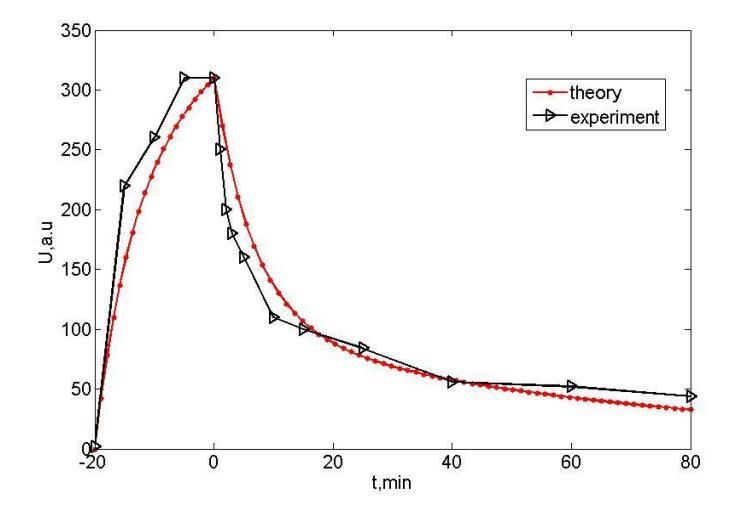
It is shown that the relaxation kinetics of optical poling can be divided into short – and long – time relaxation kinetics. Long time relaxation kinetics is fully described by diffusion coefficient Dt for the trans isomer. The short time relaxation kinetics depend on the conditions of the micro - texture grating writing and is mainly caused by the relaxation kinetics of the cis isomer and parameters for the reorientation probabilities.