
The Amperator is a powerful step-down transformer. It was made to present the Joule's law and show how much of energy is being lost in transfer lines.
The Amperator has a very low output impedance, that makes him a powerful current source. Even though the output voltage is approximately 3V AC, it can deliver up to 700Amps of current on short circuit. If we put a nail in between output clamps due to Joule's law it will heat up and melt. The current on the nail can be determined using Ohms law:
$$I = \frac{U}{R+r}\tag{1}$$
Here U – output voltage, R – samples resistance (typical resistance of a nail is 0.01Ohms), r – inner resistance of the device that is many times less then the resistance of the sample, so all of the voltage drops across the sample. Then, using Joule's law we can determine how much of heat is being exceeded.
$$Q= R\cdot I^2 \cdot t\tag{2}$$
Here I – current that flows through the sample, t – time. The Power that is dissipated in the sample:
$$P=R\cdot I^2\tag{3}$$
Even though Amperator is basicly a step-down transformer it can help a lot of people to understand where is the energy loss in transfer lines, what is inner resistance and what does it do.
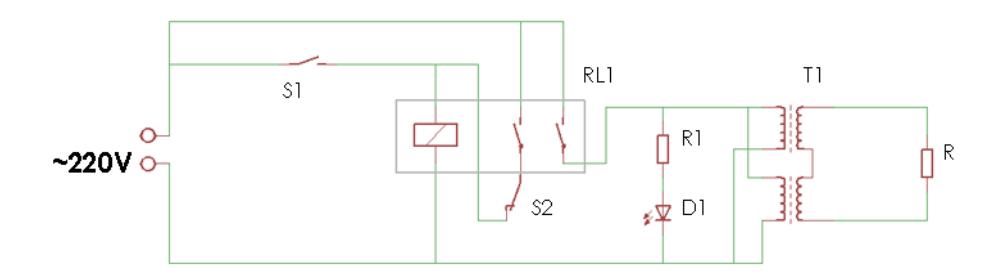
The switch S1 turns on the relay RL1, that enables current flow through the step-down transformer T1. Transformer changes voltage from 220AC to approximately 3V AC. If sample resistance R is low, a high current will flow through the circuit and a lot of ohmic heat willd be created.
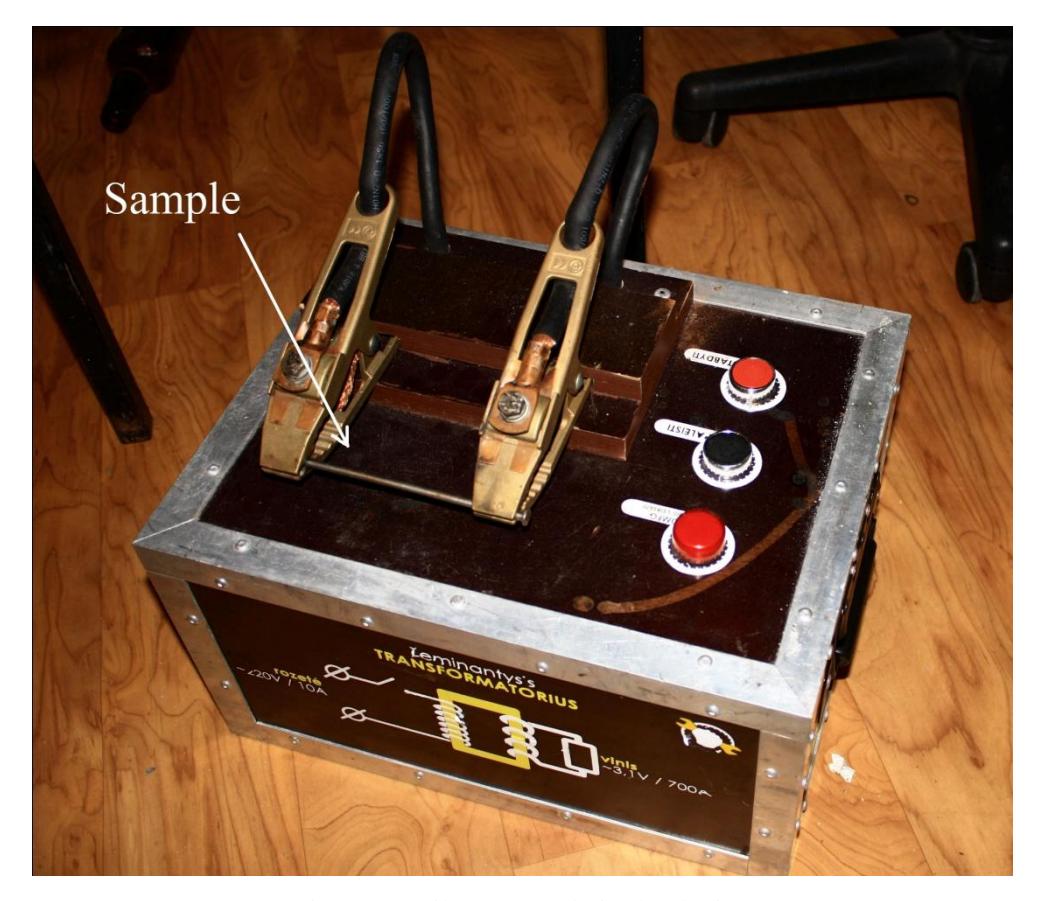
Figure 2 shows a device itself. A nails is usually used as a sample. After couple of seconds after switching on the device nail starts to glow brightly yellow and melts.