Modern pulsed fiber amplifiers and lasers are capable of providing high peak power output with excellent beam quality [1], what makes them attractive for variety of applications. Silica based rare-earth-doped fiber lasers and amplifiers usually work in infrared wavelength region but for some applications shorter wavelength light is more suitable. Frequency conversion can be accomplished using nonlinear crystals [2], however, when high peak power light pulses travel through fiber their spectrum is inevitably broadened due to phase self-modulation. This limits frequency conversion efficiency because nonlinear crystals have limited phase-matching (acceptance) bandwidths. In order to overcome this problem, in this work we investigate experimentally two methods for improving efficiency of second harmonic generation (SHG) using broadband fiber amplifier output.
Our experimental setup consisted of Yb-doped, double-clad LMA fiber amplifier with core diameter of 30 μm seeded by pulsed solid state laser working at 1064 nm wavelength. Two different solid state lasers where used for experiment: one of them generated 15 ps pulses at 4 MHz repetition rate and the other - 8 ps pulses at 100 kHz repetition rate. Fiber amplifier output was directed and focused to LBO crystal (14x3x3 mm), where frequency conversion took place in form of second harmonic generation (critical phase matching setup).
When amplifying 15 ps pulses up to 2 μJ energy in fiber amplifier, light spectrum was broadened up to 1.7 nm because of phase self-modulation. Second harmonic generation energetic efficiency of 50% was easily achieved using this radiation, as crystal phase-matching bandwidth was not exceeded. Theoretical estimation of crystal phase phase-matching bandwidth provides value of 2.2 nm, what is more than the bandwidth of radiation used for second harmonic generation. In contrast, when 8 ps pulses were amplified up to ~3.3 μJ energy, pulse spectrum was expanded much more - to about 24 nm and second harmonic generation efficiency dramatically decreased to less than 10 %. At this point, two different methods for increasing SHG efficiency were implemented and investigated.
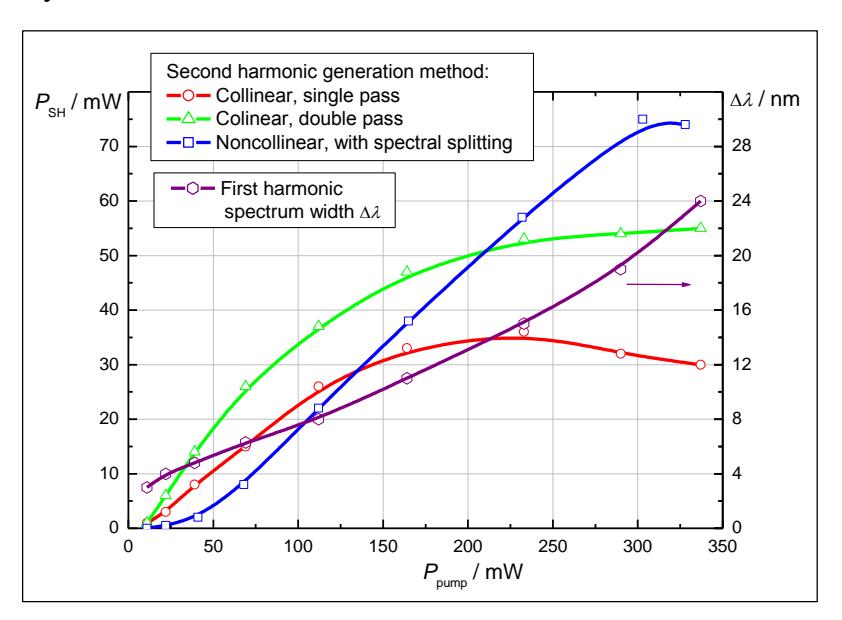
First method was based on double pass of first harmonic light through the crystal. Second pass was at some other angle in respect to crystal axes than the first one so phase matching occurred for some different wavelengths than during the first pass. This method increased second harmonic generation efficiency to about 16 % for 24 nm broad spectrum (at 3.4 μJ pulse energy).
Second method was based on spectral splitting (using dichroic mirror) first harmonic beam into two separate beams, so as half of initial beam spectrum goes to one resulting beam and half to another. Next, noncollinear sum-frequency generation was performed in LBO crystal. In this configuration second harmonic generation efficiency of 22 % was achieved (for 24 nm broad spectrum and 3.3 μJ pulse energy).
Experimental results are summarized in Fig. 1, which shows second harmonic average power and first harmonic (pump) spectrum width as function of first harmonic (pump) average power. From presented graph it can be concluded, that second method (based on spectral splitting) allows achieving highest power of SH in comparison with other two methods at highest pump power (and broadest spectrum). Frequency conversion efficiency using this method can be increased twice in comparison with conventional SHG. However, it shows not very good results at lower pump. This decrease at lower pump (in comparison with other methods) can be explained by shorter interaction length as beams travel noncollineary and the distance they overlap in nonlinear crystal is shorter.