
Recently interests in electrical fluctuations of electrical signals were expeditiously growing due to growth of nanotechnologies production perfection, as the smaller electrical devices gets, the greater electrical fluctuations can be detected in transmitted signal. Electrical noise is usually named as accidental microscopic particles deviation from average value.
Semiconductor diodes could be examined as nonlinear resistive devices, but what is in common between nonlinear element thermal and shot electrical noises? The answer was partly found when Gupta's theorem appeared in 1978, but since nowadays there are no experimental results published which could prove that theorem is absolutely correct. Usually shot noise is described with Schottky's formula $S_I = 2eI$, but this formula validates only when semiconductor diode's voltamperic characteristic's perfection coefficient $n$ is equal 1 [1-2].
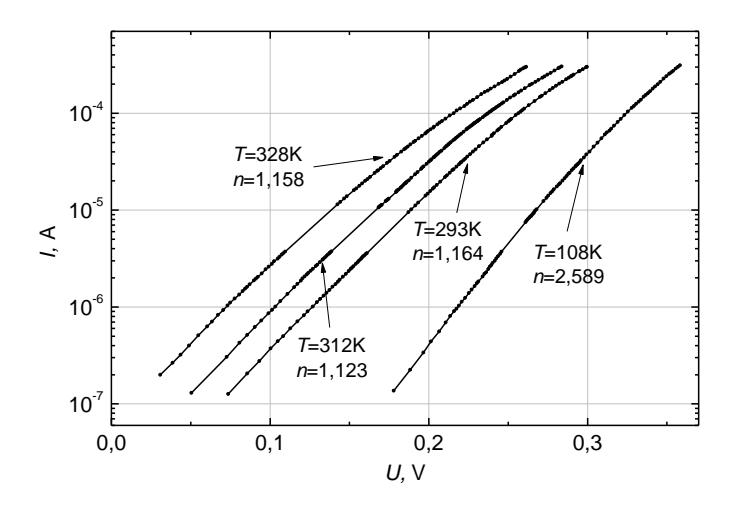
To estimate these problems, Si and GaAs Schottky diodes were chosen, to examine their voltamperic characteristics (Fig. 1) and electrical noise (voltage fluctuations) (Fig. 2 a) in wide temperature and current range. Noise measurement was made in highly shielded Noise laboratory, even measurement system was placed in metal case to maximum protects it from external electromagnetic field impact.
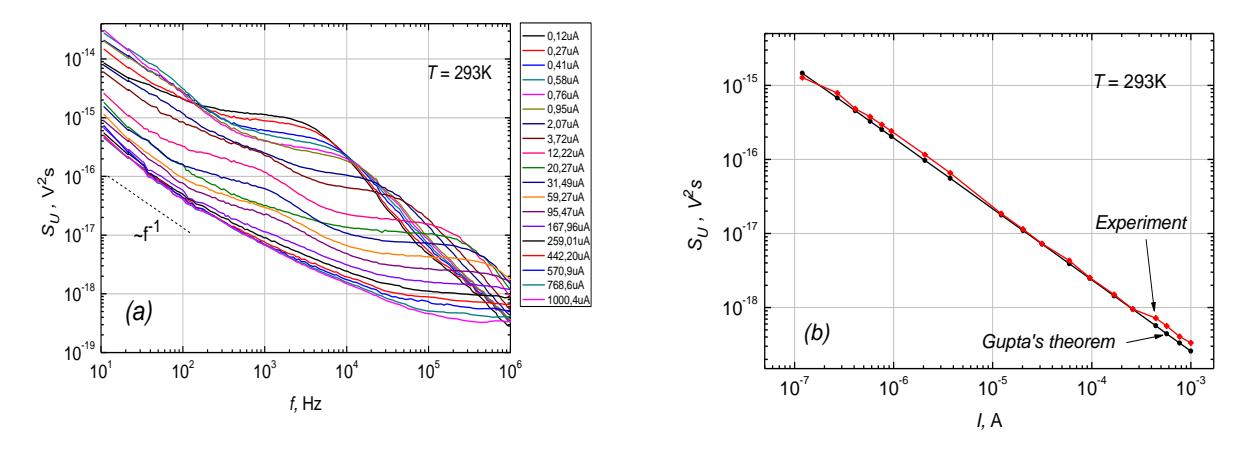
In measurements is visible that in low frequencies there is 1/f noise, which, rising frequency, merges to shot noise (Fig. 2 a). Si and GaAs Schottky diode's voltage fluctuation spectral density theoretic results, calculated from Gupta and Schottky, coincides with experiment result in low current range, however, when current gets higher, there is trivial error (Fig. 2. b).
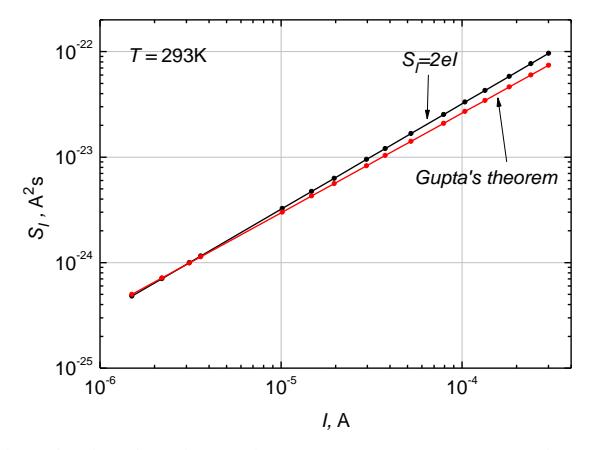
During noise investigation, were established that experiment results in Schottky diodes coincide with Gupta's theorem, while Schottky formula validates only when perfection coefficient $n$ is 1.