
Researches of epitaxial ZnO layers and ZnO-based ternary compounds, such as CdZnO are of increasing interest due to large exciton binding energy of around 60 meV in zinc oxide and recent technological achievements in fabrication of various ZnO-based structures [1]. The unique exciton features lead to efficient radiative transitions of excitonic nature for ZnO-based light emitting devices working at elevated temperatures. Temperature dependent photoluminescence (PL) spectra of the samples helps to determine the quality of epitaxial layers as well as to derive parameters that might help to describe the behavior of future devices based on these layers.
The PL of the four MBE-grown ZnO/CdZnO quantum structures samples were investigated using 10 mW continues-wave He-Cd laser with emission wavelenght of 325 nm as an excitation source. The temperature dependent PL spectra were measured utilizing the closed-circuit He cryostat, which allows the stabilization of the sample temperature in the range from 8 K to 300 K. Structures of all the samples are depicted in Fig. 1. Multi-layer sample structures resulted in more complex interpretation of observed PL peaks nature.
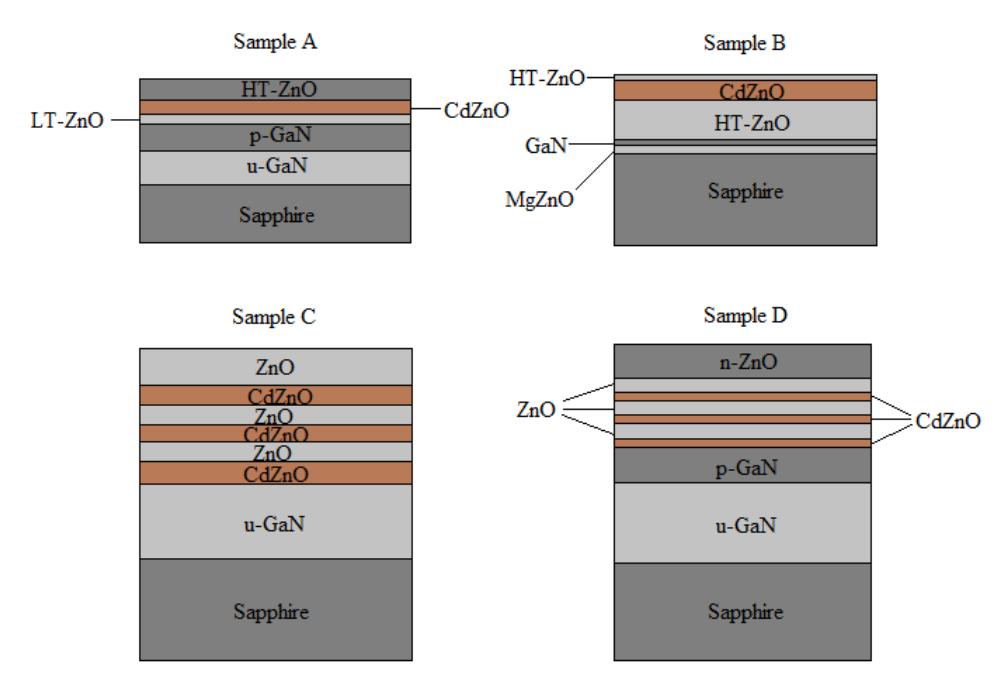
The dependences of the PL peak energies, which where all attributed to near-band-edge (NBE) emission, on temperature were fitted using empirical Varshni [Eq. (1)] and Bose-Einstein [Eq. (2)] relations [2]:
$$E_g(T) = E_g(0) - \frac{\alpha T^2}{T+\beta}\tag{1}$$
$$E_g(T) = E_g(0) - \frac{k}{\exp\left(\frac{\theta}{T}\right) - 1}\tag{2}$$
Fitting parameters $\alpha$, $\beta$ and $\theta$ where evaluated for both free exciton and bound exciton PL peaks of ZnO epilayers as well as CdZnO NBE emission peak.
Cd molar fraction in CdZnO epitaxial layers where estimated to be around 15%, 9%, 19% and 16% for samples A – D respectively.
PL intensity and full width at half maximum (FWHM) dependences on sample temperature were in good agreement with the ultraviolet ZnO PL peak being of excitonic nature. Large FWHM values for CdZnO epilayers of all the samples refers to worse crystalline quality whereas NBE PL peak is red-shifted with incorporation of Cd. Nevertheless, formation of muptiple quantum well structures (CdZnO well layers separated with ZnO barrier layers) helps to improve the efficiency of excitonic transitions by increasing their localization preventing carriers/excitons from nonradiative recombination.