
Infrared laser diodes (LDs) generally are used in optical communication systems as their narrow and stable radiation spectrum meets highly strict requirements for suppressing dispersion in fiber. However temperature changes lead to the LD radiation spectrum movement along wavelength scale and mode-hopping effect occurs [1]. During such phenomenon radiation spectrum of Febry-Perot (FP) LD is unstable – highly correlated intense optical and electrical fluctuations are observed [2]. It is known, that low frequency noise characteristics are very sensitive to physical processes which take place in semiconductor materials [3], so in this project noise research was invoked in order to clarify the origin of intense fluctuations during mode-hopping phenomenon in FP LDs.
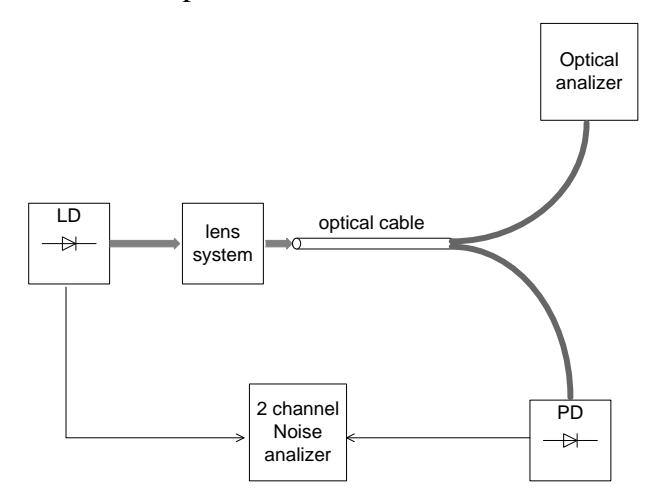
InGaAsP/InP Febry-Perot lasers radiating at 1.3 μm were used for the investigation. LD radiation spectrum and low frequency (20 Hz – 200 kHz) noise characteristics (optical, electrical noise and cross-correlation factor between them dependency on frequency, current and temperature) have been measured simultaneously (Fig. 1.).
Typical electrical and optical fluctuations of FP LD at stable operation region are characterized by $1/f^{\alpha}$ – type noise spectra and small (from -10 % to +10 %), almost non-dependent on frequency cross-correlation factor between them. Origin of such noise in semiconductor devices usually is related to generation-recombination (GR) processes through generation-recombination and capture centers with widely distributed relaxation time. Those centers are formed by defects and impurities in the device structure.
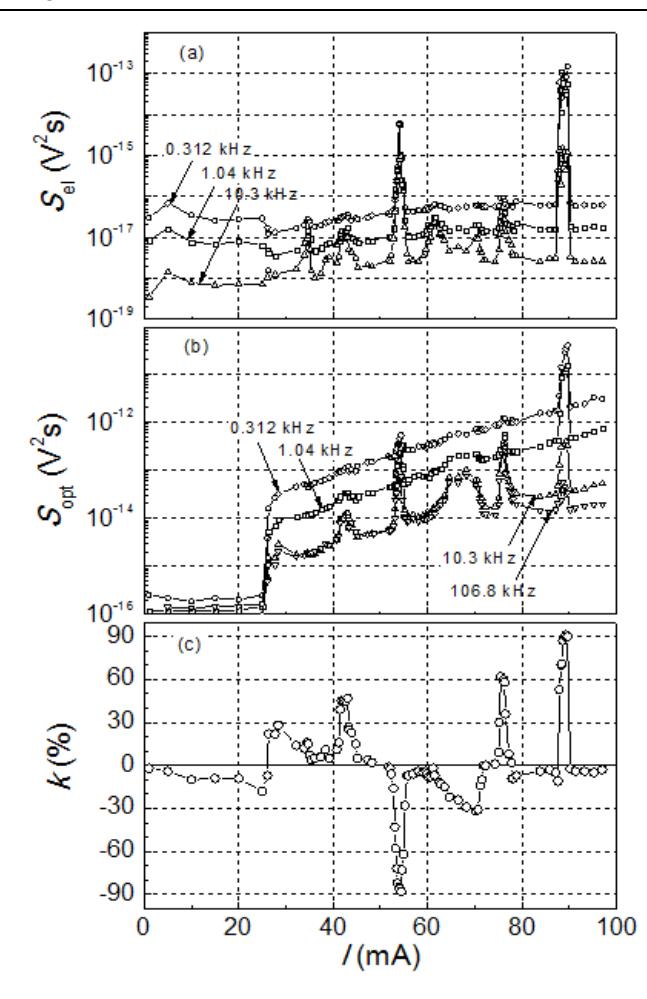
However when mode-hopping effect occurs, electrical and optical noise intensity, as well as the cross-correlation factor between them, strongly increase (Fig 2). Intense fluctuations observed at this point are characterised by Lorentzian spectrum (it is caused by generation-recombination ant carrier capture processes in centers formed by defects in the barrier layer) and highest correlation is found at frequencies, close to the spectrum cut-off frequency, which ranges 1 kHz to 1 MHz. Therefore characteristic times of processes that take place at device during mode-hopping effect ranges from 0.2 μs to 0.2 ms.
High cross-correlation factor between electrical and optical noise during mode-hopping effect shows that processes which determine it at this operation point take place in the active region of LD. Moreover different cross-correlation factor value and sign, different cut-off frequencies at different LD operation conditions indicate that there are several physical processes that take place in the device structure during mode-hopping. Therefore there are several GR centers in the sample and they are activated at different operation conditions.