
Thallium bromide (TlBr) is an attractive and promising material for X- and γ-ray spectroscopy because of its wide bandgap (2.68 eV), high density (7.56 g/cm3) and high atomic numbers (Tl:81 and Br:35). Such properties ensure a high photon stopping efficiency. Nevertheless one of the main problems still hindering practical applications of TlBr is presence of the ionic conductivity, which sensitively depends on the temperature and makes device characteristic unstable in time.
We had investigated two samples of TlBr. The first sample was grown by the Bridgman–Stockbarger method. The sample size was 3:2:1 mm. The second sample was grown by the hydrothermal recrystallisation method and was purified using traveling molten zone method (7 times). Its size was 5:3:2 mm.
We had investigated photoelectrical and current transient properties of TlBr from 100 K up to 300 K, where the effect of the ionic conductivity changes notably. After measuring the spectral dependencies several defect related bands were identified. The curves were approximated using Lukovsky model. Positions of the defect levels were identified being as follows: 0.8 eV, 1.1 eV, 1.6 eV and 1.9 eV. The defects could be related with the impurities in TlBr crystal such as: Fe, Cu, Ba, Cr, Li. The light induced enhanced photoconductivity phenomenon was identified at low temperatures after the photoexcitation of the samples by the intrinsic light.
Non-monotonous conductivity variation with temperature was identified, demonstrating mobility-related maximum that was superimposed on an intrinsic conductivity growth (Fig.1).
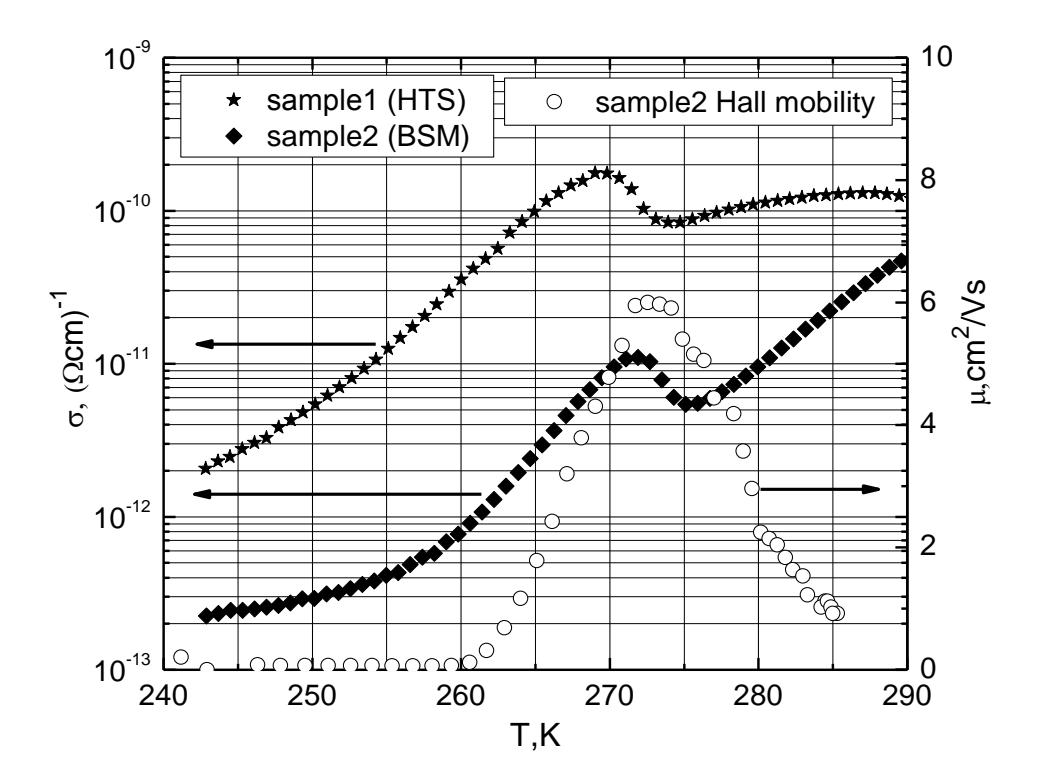
After measuring the thermally stimulated currents several defect traps were identified. The curves were approximated using TSC model. Their thermal activation energy values were 0,2 – 0,35 eV, and 0,74 – 0,79 eV.
The slow degradation of the samples was observed, which is related with the change of the potential barrier heights, and variation of the effective activation energy values of the defect bands. Moreover, photoconductivity of the samples decreases too. This could be explained by the creation of new recombination channels in the crystals due to the diffusion of Tl ions.