III-nitride wide bandgap semiconductors are essential in the creation of solid-state ultraviolet (UV) light sources and detectors. These devices are expected to have a wide application range in medicine diagnostics, therapy, detection of biological and chemical agents, water purification and data storage.[1]
UV lasers are based on AlGaN materials and decreasing the emission wavelength requires high-aluminum-content AlGaN layers in active region. Although recently AlGaN epitaxial layers have received much attention and investigative efforts, observation of stimulated emission has been complicated even under optical excitation and data on it is very scarce. Situation is even worse for high aluminum content AlGaN/AlGaN multiple quantum well (MQWs) structures. Also, the development of AlGaN-based UV laser faces technological growth problems, which cause low quality of layers and result in an increase of the threshold of stimulated emission or even in the vanishing of it.
In this report, we present the study of stimulated emission and its properties in AlGaN MQWs structures with different well width: the well width in different samples varied from 2.5 to 5.0 nm. Aluminum content in the wells and barriers was equal to 35 % and 49 %, respectively. The samples were investigated by photoluminescence (PL) spectroscopy; measurements were carried out in a wide temperature range of 20 – 300 K under various excitation power densities (0.2-10 MW/cm2). Stimulated emission was measured in edge emission configuration.
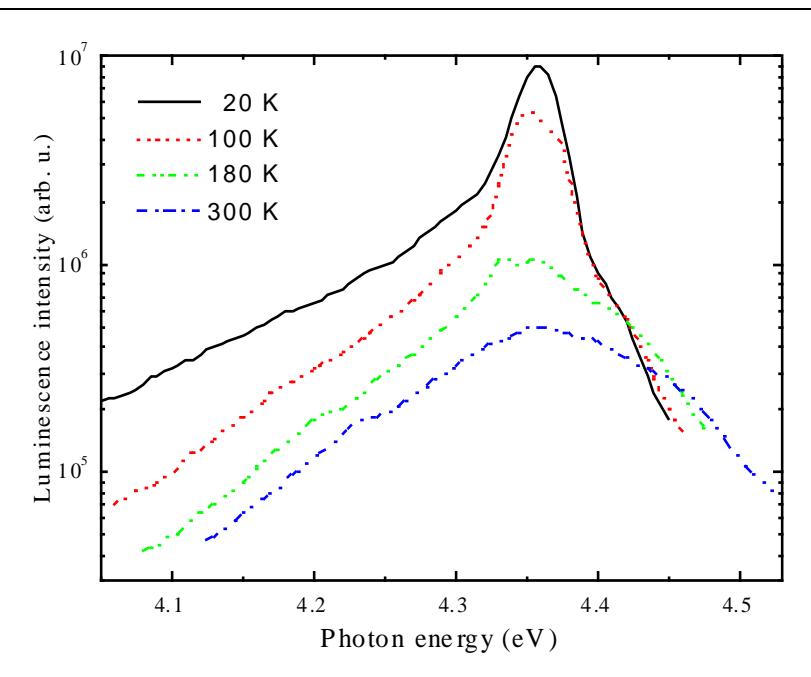
We demonstrate stimulated emission threshold dependences on temperature for different samples. While stimulated emission threshold increases with temperature as expected, the threshold temperature dependence is somewhat different for structures with different quantum well width. Additionally, we show that the peak position of stimulated emission band does not exhibit obvious shift with increasing temperature, once spectra are shifted along $x$ axis to compensate temperature dependence of bandgap (see Fig. 1). This behavior of stimulated emission may be explained by non-equilibrium carrier recombination from states localized near mobility edge.