
Nowadays the noncollinear optical parametric chirped pulse amplification (NOPCPA) [1] is a well established technique for generation of ultra-high-power, few cycle optical pulses. A number of published analytical treatments and numerical simulations on NOPCPA performance optimization focus mainly on achievable gain bandwidths and conversion efficiencies. However in case when pulse length in space is shorter than its transverse dimension it is necessary to consider also the possible spatio-temporal pulse distortions, such as pulse front tilt, angular dispersion, spatial chirp arising as a consequence of noncollinear parametric interaction geometry of NOPCPA.
In this contribution we present the results of theoretical and experimental study on transformation of chirped pulse spatio-temporal characteristics during the amplification in femtosecond noncollinear parametric amplifier.
As it was demonstrated by Akturk et al. [2], pulse front tilt and angular dispersion are not equivalent, thus from pulse front tilt one cannot conclude that pulse has angular dispersion. Alternatively, pulse front tilt can originate from the presence of simultaneous spatial and temporal chirps. The origin of spatial chirp and signal pulse tilt during amplification in NOPCPA can be explained with the help of Fig. 1.
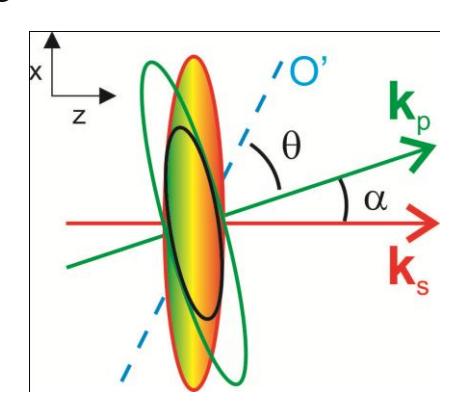
As one can see the gain contour (defined as overlap area and depicted with the black line) is tilted, i.e. at different time slices different part of signal beam (red line) is amplified. Therefore, during parametric amplification powerful pump (green line) makes signal pulse tilted.
Moreover, if input signal pulse is temporally chirped then different wavelengths are amplified at different transverse positions (Fig. 1), thus amplified signal pulse acquires spatial chirp as well.
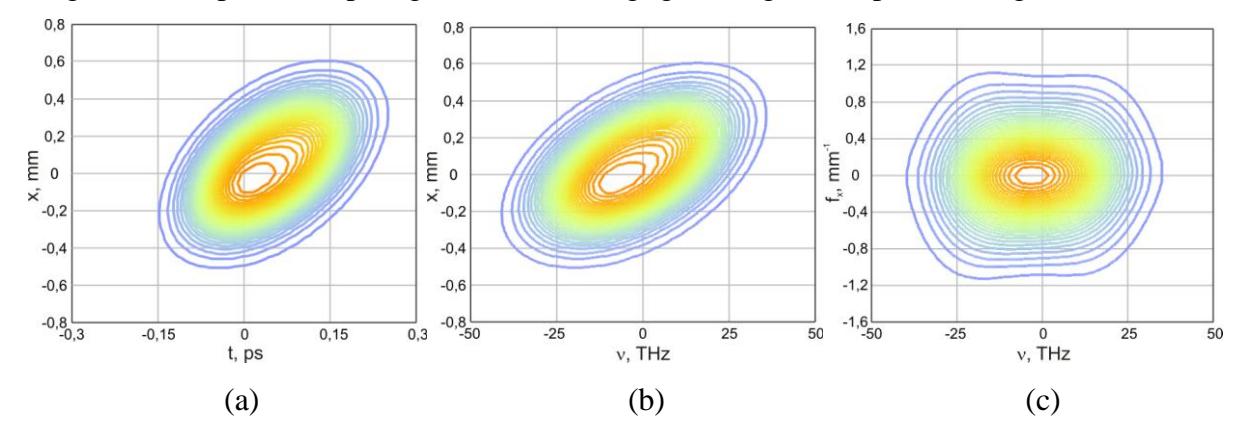
These considerations were approved by (2D+1) numerical simulations of BBO-based femtosecond NOPCPA. Signal pulse spatio-temporal characteristics after amplification obtained by numerical modeling are depicted in Figs. 2a-2c. As we can see amplified signal pulse is tilted (Fig. 2a), has spatial chirp (Fig. 2b) and has negligible angular dispersion (Fig. 2c).
Also, analytical treatment of this phenomenon have been performed and two important expressions were obtained from which we can conclude that after amplification signal pulse may have angular dispersion or spatial chirp or both at the same time. It depends on the amount of temporal chirp of the signal pulse before amplification: angular dispersion is always decreasing by the rate proportional to $\gamma^2$ when increasing signal temporal chirp $\gamma$, whereas spatial chirp is increasing by the rate proportional to $\gamma$.
The theoretical considerations were verified experimentally as well. Obtained results show, that chirped pulses acquired spatial chirp during parametric amplification in case of not matched pulse fronts. This spatial distortion of amplified pulse corresponded to spatial dispersion parameter of ~1 μm/nm, while the angular dispersion was negligible.