We present a study of optical properties of Spiral Zone Plates (SZPs) [1]. The SZPs are apertures which not only focus light, as well-known (Fresnel) Zone Plates, but also modify its angular momentum. The emphasis of the research is put on the spatial shape of foci, as well as on the behaviour of the beam near a focus.
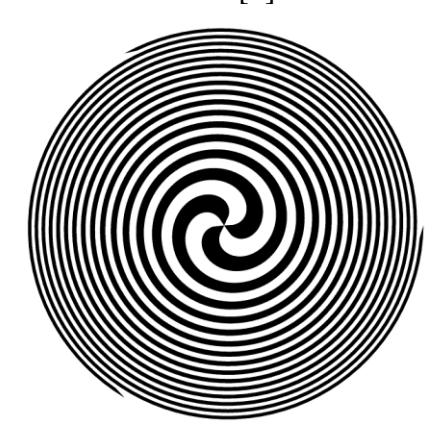
In the experiment we use a binary SZP, that is a mask [2] consisting of transparent and opaque parts - one/zero transmission (Fig. 1). Such an aperture gives a series of foci with focal lengths $f/n$ (where $f$ is the major focal length and $n$ is an integer). The number of arms indicate the topological charge of the vortex for the major focus. The nth focus has the topological charge $n$ times that of the major focus.
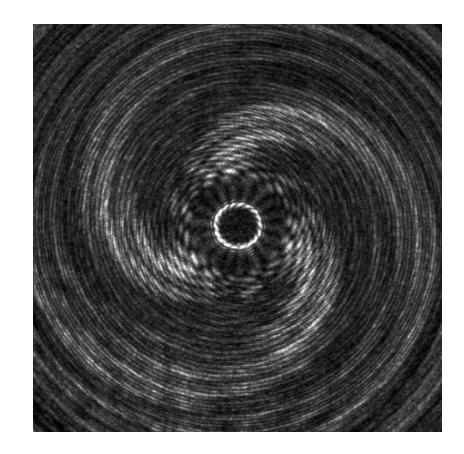
The SZP foci have unique properties. The light in the focal plane forms a thin ring with radial fringes (Fig. 2). The radial fringes bend as the plane is moved towards or away from the aperture.
Our experimental findings are supported by both a numerical simulation and a theoretical model based on the Ref. [3].