
Graptolites from erratic boulders are known since the 19th Century.
Graptolites from Baltic erratic boulders serve as a tool for taxonomic, morphological, phylogenetic and evolutionary investigations, as well as for population dynamic studies and partly for stratigraphy and Quaternary geology which documents the significance of their investigation.
Mokrzeszów quarry is located in Lower Silesia, Southwest Poland, about 80 km southwest of Wrocław or 60km east of Jelenia Góra, between Wałbrzych and Swidnica towns.
Mokrzeszów quarry is located in the area of the Cenozoic tectonic graben Roztoka-Mokrzeszów, which separates here Świebodzice depression from the Fore-Sudetic Block. The thickness of Cenozoic sediments exceeds 400 m. There are tens of meters composed of glacial grave originating from the Saalian glacier. Lower Palaeozoic limestone is dominating (35–45%) together with Scandinavian crystalline rocks (32–39%). The minor part consists of quartzite, white sandstones, Mesozoic limestones, flints and grey granites. Some of them might originate from the Sudetes.
"Baltic limestone" are found in Central Europe Lowland from Netherlands in the West to West Lithuania in the East, from Rügen Island and the South coast of the Baltic Sea north of Lower Silesia in the South. The southern distribution border of Silurian gechiebes with graptolites coincides with their maximum distribution in Pleistocene (Saalian) glaciers.
Silurian Graptolites variety is enough wide both species quantity and age. Monograptus flemingi* and Pristiograptus pseudodubius* are the oldest graptolites, found in Mokrzeszów quarry. They are from the middle Wenlock (radians – lundgreni* biozones). Gothograptus nassa* and Pristiograptus parvus* (parvus – nassa* biozones), P. praedeubeli, P. deubeli* (praedeubeli – deubeli* biozones) are found in the upper Wenlock. P. parvus and G. nassa (parvus biozone) were on the one side of the boulder, and the younger P. praedeubeli (praedeubeli biozone) species – on the other side. Mostly the boulders with the lower Ludlow graptolites are found: Neodiversograptus nilssoni, Colonograptus colonus, Saetograptus varians, S. chimaera, Bohemograptus bohemicus, Monograptus uncinatus, P. dubius frequens, Lobograptus progenitor, L. scanicus*.These graptolites are from nilssoni – scanicus* biozones. Slovinograptus balticus* from balticus* biozone (Uppermost Ludlow) was found in Mokrzeszów quarry. So, in Mokrzeszów quarry the middle Wenlock – uppermost Ludlow (the lower Ludlow graptolites dominate) graptolites are found.
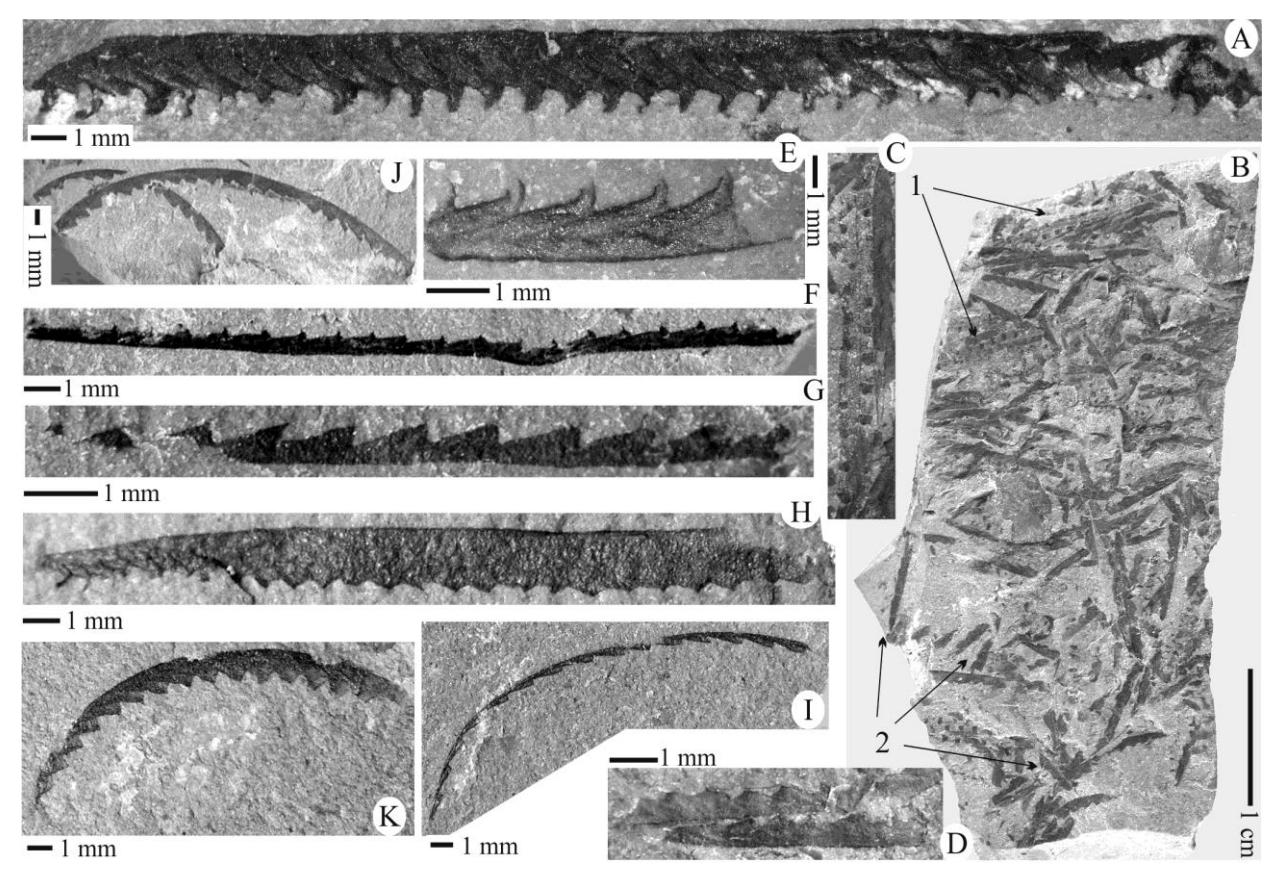
The number of investigated samples may not be identical with the real number of glacial erratic boulders, since some of the samples could be fragments of larger boulders. However, it is obvious that boulders with graptolites from the lower Ludlow dominate. The oldest Silurian boulders from that locality refer to the belophorus–lundgreni biozones, while the youngest come from the bohemicus tenuis–kozlowskii biozones. The latter represent the youngest Silurian erratic boulders in Europe yet known. Whether or not this quarry yield even younger Silurian graptolite-bearing erratic boulders needs further investigations.