
The formation of hydrogen bond is very important in many aspects of physics, chemistry and biology. It can alter properties of the matter and influence processes occurring in chemical and biological systems. For these reasons, hydrogen bonded systems are subjects of numerous experimental and theoretical studies. Carboxylic acids, which form a variety of different complexes via hydrogen bond, are an example of such systems. Formic and acetic acids form three types of dimers. Their structure and the strength of hydrogen bond depend on the length of the aliphatic radical [1, 2]. However, the alterations of the strength of the hydrogen bond, when the aliphatic radical is prolonged, are not linear. In this work we present a study of heavier carboxylic acids hydrogen bonded associates. The aim of this study is to determine the links between the length of the aliphatic chain and the self association of the carboxylic acids.
The experiments were performed using low temperature infrared spectroscopy method. The samples were prepared using matrix isolation technique: the molecules of the acid and inert gases (in this study we used argon (Ar)) were mixed in the vacuum line and deposited on cold (9 – 10 K) CsI window in the close cycle helium cryostat. Gas flow into the cryostat was regulated using the needle valve. The acid to argon ratio was 1:200. Infrared absorption spectra were recorded using IFS 113v* spectrometer from Bruker* with infrared radiation source “glowbar" and liquid nitrogen cooled MCT (mercury-cadmium-telluride) detector. Spectra were obtained using 0.1 and 1 cm-1 spectral resolution. The spectral region corresponding to C=O stretch vibration of carboxylic acids is presented in figure 1.
It has been shown that binding energy of the associates of small carboxylic acids (formic, acetic, propanoic) is decreasing as the length of the radical chain is increase. The decrease is not linear and alternates for even and odd number of carbon atoms in the radical chain. The alternation depends on how the CH3 group is situated in respect to C=O bond. The strength of the hydrogen bond is indicated by the red shift of the C=O vibration band of carboxylic acid complex in respect to the corresponding monomer band. The stronger the bond, the larger the red shift. [3].
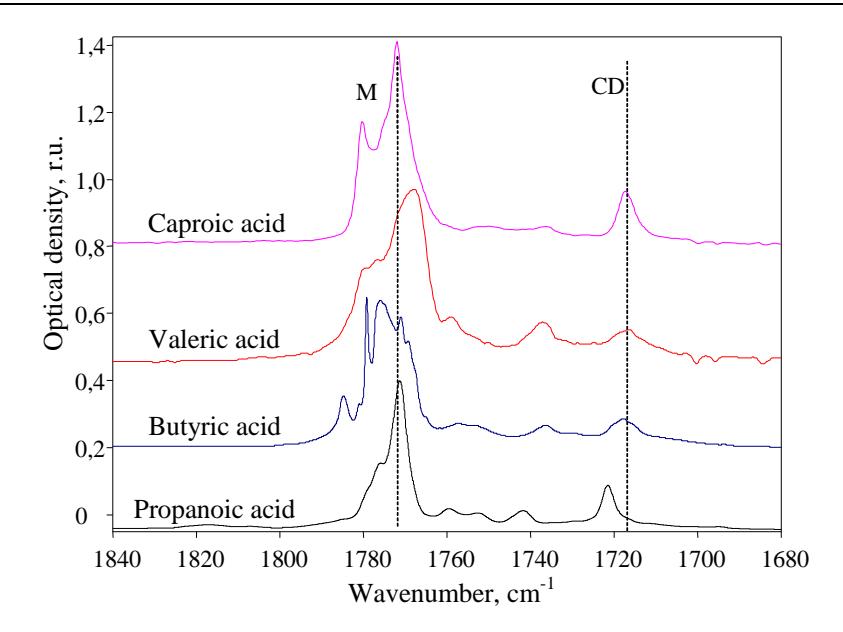
In this work, the self association of heavier carboxylic acids (butyric, valeric, caproic) was analysed. Their infrared absorption spectra are very similar (Fig. 1). According to the spectra obtained, it was determined that in low temperature matrices two types of self associates form: stabile cyclic and less stabile, corresponding to intermediate state, open dimers. As mentioned above, the strength of the hydrogen bond, or the magnitude of binding energy, can be evaluated observing the red shift of the C=O vibration band of the dimer in respect to the corresponding monomer band. It is shown in figure 1 that in case of the heavier carboxylic acids (the ones that have more than three carbon atoms in their radical chain) the red shift is the same. These results allow us to assume that the binding energy of the self associates is very similar and the length of the C-C chain has no further influence on its magnitude.