Atmospheric aerosol particles, which are very small and suspended in the air, affect the Earth's climate by directly scattering and absorbing the atmospheric radiation and indirectly by acting as cloud condensation nuclei and modifying the optical properties of clouds. Furthermore, human exposure to fine particulate matter is associated with adverse impacts on human health [1] and the environment [2]. Because of the high variability of the properties of atmospheric aerosol particles, simplification are needed before the parameterized particle number size distribution can be used as input data in global climate models. [3].
In this work we focus on the strongest nucleation episodes:
2009-04-06, 2009-04-19, 2009-04-21, 2009-05-10, 2009-05-13, 2009-05-23, 2009-05-26, 2009-06-12, 2009-07-27, 2009-08-04, 2009-09-20, 2009-10-10, 2009-11-23, 2009-12-01. The aerosol particle concentration measurements were performed at the Preila environmental pollution research station (55°55'N, 21°00'E, 5 m above sea level) in the coastal/marine environment. Scanning Mobility Particle Sizer (SMPS) spectrometer, manufactured by IfT, Germany and Condensation Particle Counter 1500 (CPC), manufactured by Institute of Physics, Lithuania were deployed at the site and provided real-time, continuous measurements of aerosol size distribution and aerosol concentration.
Aerosol particle size distribution was parameterized by fitting multi log-normal distribution:
$$f(D_p, \vec{D}_{pg,i}, N_i, \sigma_{g,i}) = \sum_{i=1}^n \frac{N_i}{\sqrt{2\pi} \log(\sigma_{g,i})} \times \exp\left[-\frac{\left[\log(D_p) - \log(\vec{D}_{pg,i})\right]^2}{2 \log^2(\sigma_{g,i})}\right]\tag{1}$$presented by Whitby [4]. The main objective of the fitting is to obtain the log-normal parameters: geometric mean diameter Dg, mode number concentration Ni and standard deviation σg, that best fit the measured particle number size distribution and thus describe the properties of the atmospheric aerosol particle formation.
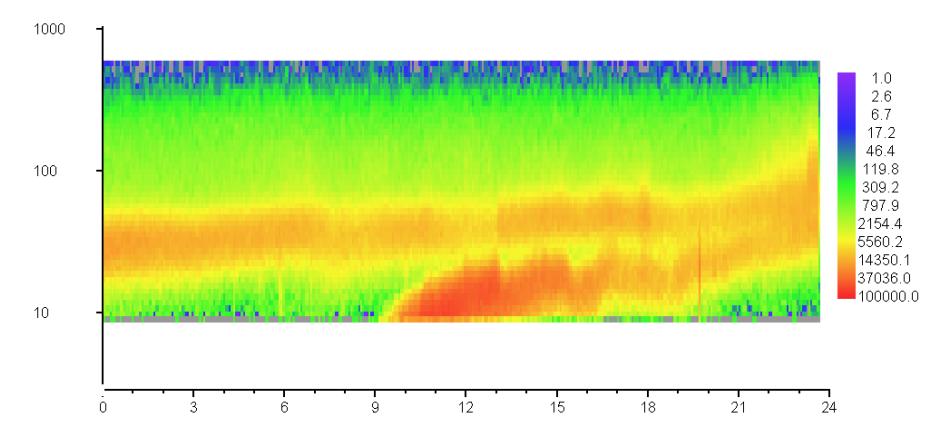
In this study, we used DistFitTM (Chimera Technologies, USA) software that parameterizes aerosol particle number size distributions with the multi log-normal distribution functions. DistFitTM software revealed that there were three modes in aerosol particle number size distribution during nucleation episodes in Preila. Selected size ranges for modes were: Nucleation: 3 - 20 nm, Aitken: 20 – 100 nm, Accumulation: 100 – 1000 nm. Parameterization showed that main multi log-normal distribution parameters are: Ni=6.67E+04, σ=1.57, Dg=14
nm., Ni=9.18E+04, σ= 1.77, Dg=43.6 nm., Ni=13.94+04, σ=1.83, Dg=114 nm., for nucleation, Aitken, and accumulation modes respectively.