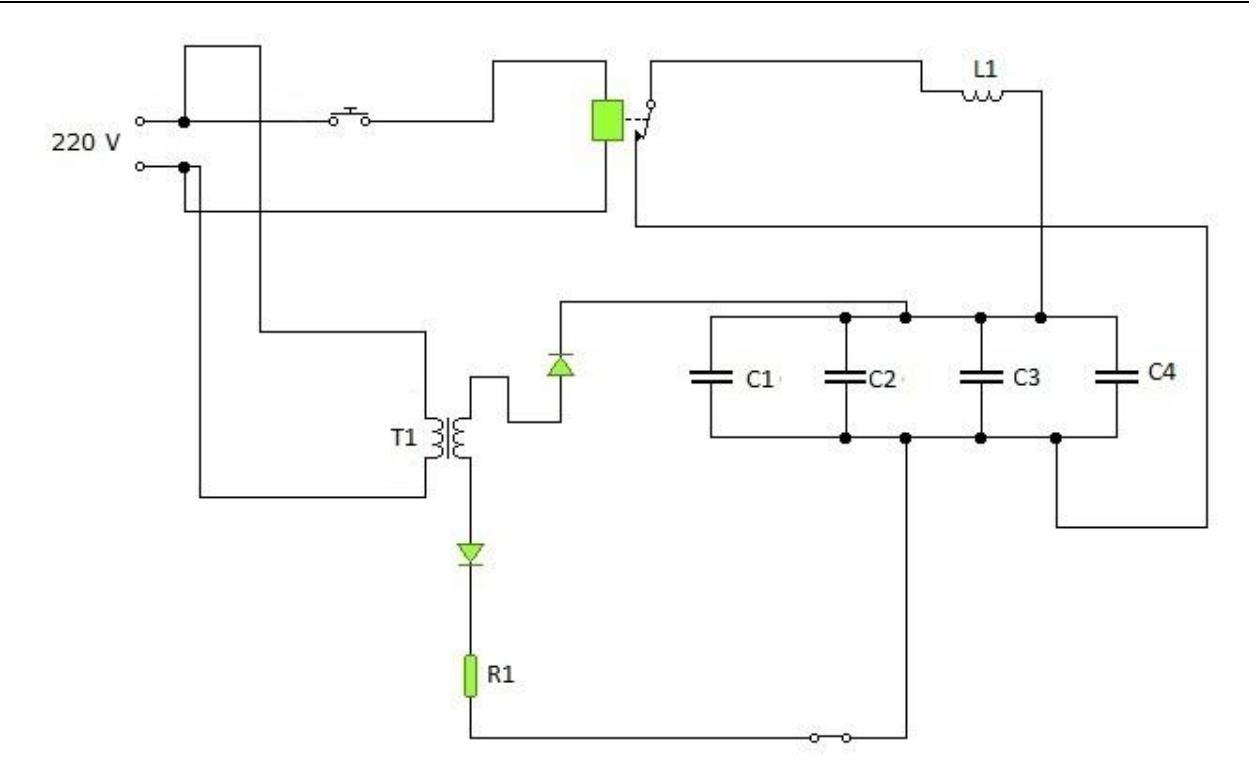
This device was created to show the abilities of inductive force to students and to explain the basic principles of electric and magnetic fields. Alternating electric current through a can induces a very strong magnetic field, which results in crushing of the can.
The main components of the can-crusher are:
- Microwave oven transformer;
- Four capacitors;
- Trigatron;
- A couple of resistors;
- Diode bridges;
- Electromagnet.
This device is powered by 220V alternating current, which is a standard in Europe. When the device is turned on, the voltage is increased to approximately 2.1 kV in the transformer T1. Then the high voltage current passes through the diode bridge, which was made from 15 cheaper diodes, and we have a direct current of 3kV. Resistor R1 is used to reduce the current, so that the conductors C1,C2,C3,C4 would be charged slower, preventing overcharge and explosion. Then when a special switch, which is covered in oil to prevent short circuiting, is turned on, the current travels through wires and starts charging four parallel connected conductors. In about one minute the conductors are charged to their full capacitances, containing about 2,5kJ of energy. The switches are then turned off to stop the current flow to capacitors. At this point the can-crusher is charged and ready. A thick wire from one end of a capacitor is wound into a coil L1 and connected to special switch called "trigatron". When a trigger is pressed an alternating current flow through separate wires into the "trigatron" which closes in the two ends of the wire connecting capacitors. When an air gap is reduced, the 3kV electricity ionize air ("fires") thus the circuit is then closed. When the spark gap fires, current rapidly climbs in the work coil and it creates a rapidly increasing magnetic field within the work coil. Through electromagnetic induction a huge circulating current is induced within the can which then creates a magnetic field of the can. These magnetic fields are of the same polarity and push each other. Because the can is thin it can't hold the magnetic force that is applied, resulting in the crushing of the can.