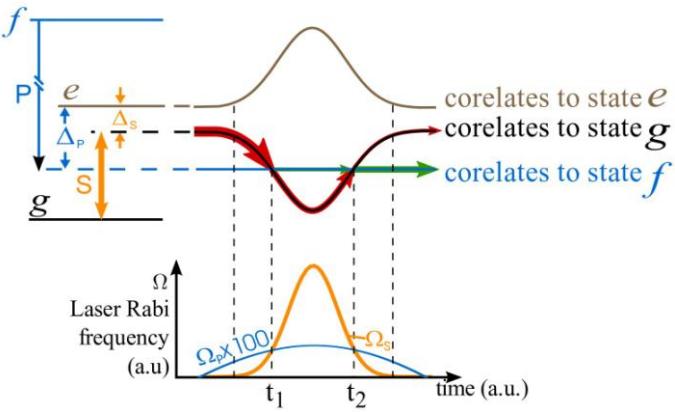
Interference of laser-dressed states can be observed when light-induced crossings of energy levels enable the population to split between distinct excitation pathways that recombine afterwards. In this talk we present observation and interpretation of such interference patterns obtained in a Ramsey-type experiment in a supersonic Na/Na2 atomic/molecular beam[1].
The excitation pathways are generated by applying two laser fields in an open three level ladder system g-e-f as seen in Fig. 1. In the experiment, the dressed states are spatially varying – the two lasers are cw and cross a supersonic sodium beam, coupling the g-e-f ladder. The lasers are focused in such a way that a strong and short (tightly focused) pump laser couples the two lower levels g and e, and weak and long (less tightly focused) probe laser couples the intermediate level e and the upper level f. The energy difference between the dressed states is determined by the pump field Rabi frequency and its detuning off from resonance. This particular arrangement produces the excitation spectra of level f consisting of oscillatory patterns with distinct maxima and minima that are characteristic to interference patterns. Detailed numerical calculations based on the dressed-state picture show that this particular arrangement of dressing fields can be used to vary the spatial distribution of highly excited atoms, which can be precisely controlled by varying the frequencies and intensities of both laser fields.