
The spectral region of 1.5 µm is very attractive, as it is supposed to be eye-save and has wide technical and technological applications. The configurations of such lasers are rather different. There are short length resonators and fiber optical amplifiers of different lengths (from few cm up to several meters); different variants of glass lasers and crystal active media lasers, which use end or transverse pumping scheme, laser diode pumping or pumping by Ti: sapphire laser. Nowadays, the most popular system of this type is a diode pumped laser system with glass media co-doped with erbium and ytterbium ions [1, 2].
The question about geometrical and power parameters optimization for this laser type remains actual. In the literature optimizations (for threshold, media length, slope) are done mostly for fiber optical amplifiers; short active media lasers optimization is mostly abandoned.
We held out numerical simulation of short laser. It revealed [2], that optimal geometric and power characteristics can also be determined for this type of lasers.
We consider one-dimensional short-laser model with an active medium been a glass matrix co-activated by Er and Yb ions. We use the four-level schema for the descriptions of the dynamics of populations Yb+ and Er+ ions (the up-conversion processes has been neglected).
For the evolution of dimensionless intensities has been used the propagation equation: $$\frac{\partial f_{\pm}(x,t)}{\partial t} \pm \frac{\partial f_{\pm}(x,t)}{\partial x} = \left(k_{g1}n_4(x,t) - k_{g2}(1 - n_4(x,t))\right) \cdot f_{\pm}(x,t) - k_l \cdot f_{\pm}(x,t) + R_{lum}^{\dagger} n_4(x,t) \tag{1}$$
Polarization and inhomogeneous media issues were not taken into consideration.
Here we discuss results of research towards optimal threshold and slope values. Threshold power dependence on active media length is given on fig.1a for several pump absorption coefficient lp (that is, for several Yb ion concentrations). An qualitative explanation for minimum can be given.
In case of short active media amount of absorbed energy is rather small, so higher puming power level is required to reach generation threshold. With the increase of media length L amount of absorbed energy raises, so threshold value lowers down to some minimal value. In the case of long active media most power is absorbed near input mirror and the other media part is excited relatively low. This part introduces neglectable amplificcation, and increases losses that lead to threshold value increase.
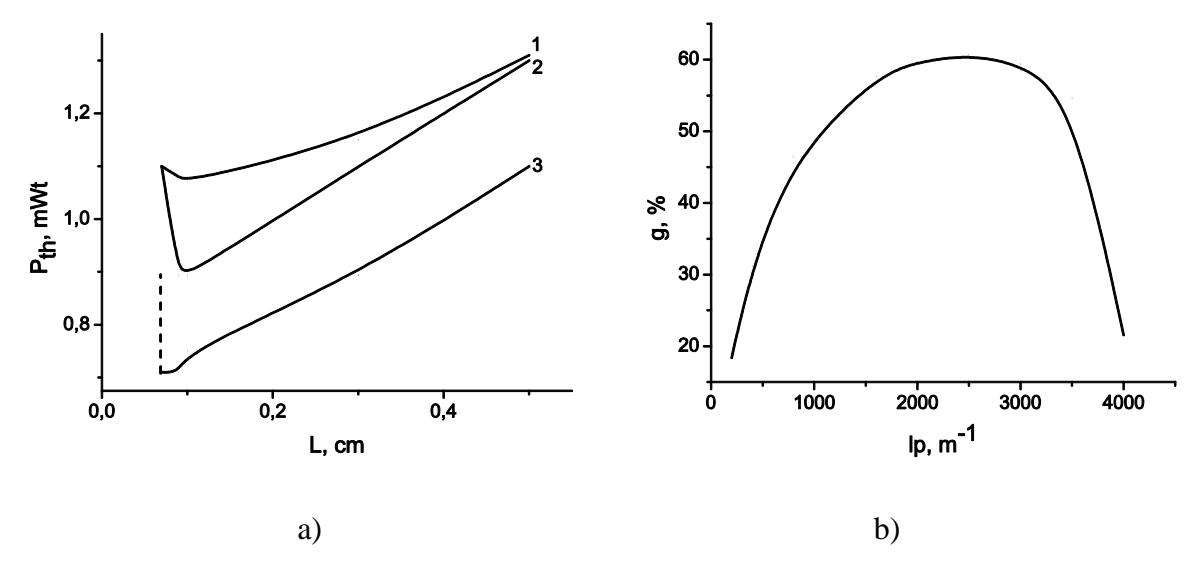
Maximum on fig. 1b in slope versus lp dependence can be explained in the same way. However we point out that despite the same explanation, regions of optimal threshold and slope values differ.