M. Rutkauskas1, L. Maigytė2, M. Peckus1, 2, K. Staliūnas2, M. Malinauskas1
1 Laser Research Center, Department of Quantum Electronics, Vilnius University, Saulėtekio Ave. 10, LT-10223 Vilnius, Lithuania
2 ICREA, Departament de Fisica i Enginyeria Nuclear, Universitat Politecnica de Catalunya, Colom 11, E-08222 Terrassa, Barcelona, Spain
Photonic Crystals (PhC) have generated high interest as light flow manipulation elements due to possibility of forming photonic bandgaps in wave frequency domains [1]. Lately, it has been found out that the spatial dispersion is also modified in PhCs [2]. One example of spatial manipulation of light is a self-collimation of the beam due to the appearance of flat segments on the spatial dispersion curves [3,4]. In addition, to effects occurring inside the PhCs, crystals with particular dispersive properties show super-lensing effects [5]. However, to produce PhCs with appropriate parameters is rather a complex task. A Laser Multi-Photon Polymerization (LMPP) is the best means of fabrication of 3D photonic elements of elaborate woodpile geometry [6].
Here we present a light collimation by 3D PhCs, which were made by a LMPP technique. LMPP is a direct laser writing technique based on ultra-localized polymerization reaction initiated by nonlinear absorption of short pulsed light in the tiny volume of the photosensitive material. Moving the sample relatively to the fixed focus spot one can point by point modify the material along the scanning trace with subdiffractional resolution [7].
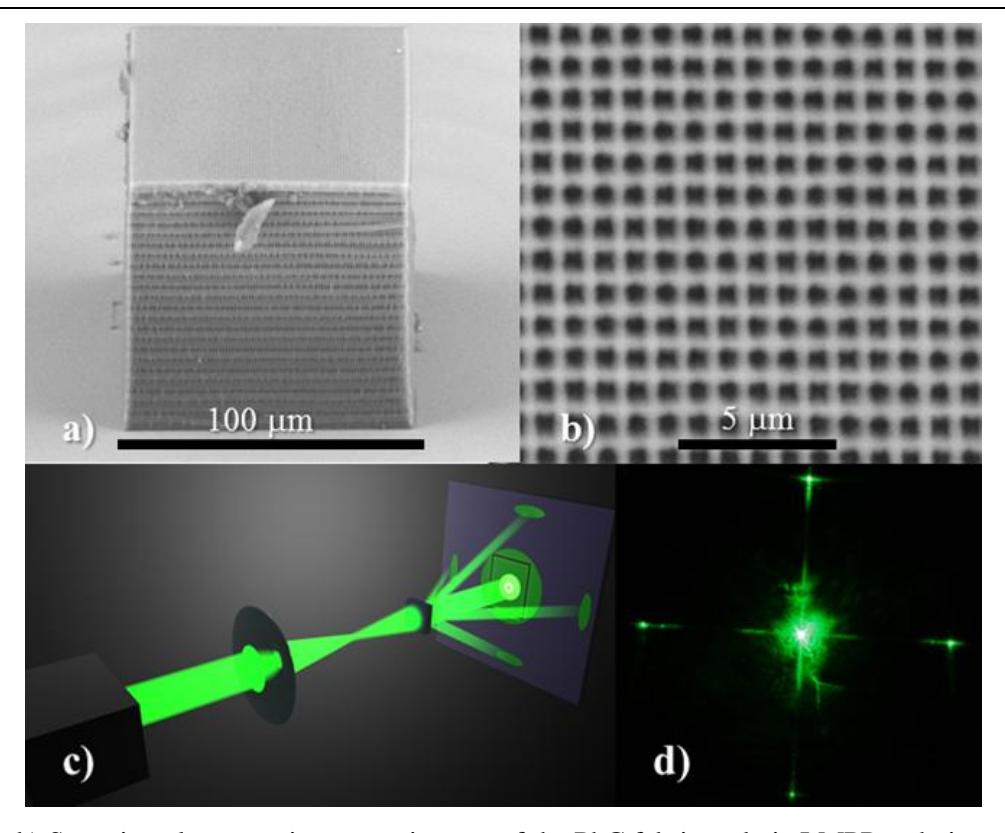
The produced PhCs were investigated using custom made observation setup (Fig. 1 c). The sample containing PhC was set behind the focal plane of 532 nm wavelength laser beam focused by 10x microscope objective lens. Illumination of PhC lead to appearance of well-collimated beam in the far field area and the four first order diffraction maxima (Fig.1 d). Measured diffraction angles between the central and the first maximum were 31° and this result correlates well with transverse period of the PhC. The beam remains well collimated even over long distances behind the sample.
Fig. 1. a), b) Scanning electron microscope images of the PhC fabricated via LMPP technique. a) Side-view of the crystal showing longitudinal period, b) PhC view from above demonstrating transversal period. c) Observation of well-collimated beam behind the PhC using laser beam. d) Transmitted intensity distribution, which is observed on the remote screen 9 cm away from the crystal, when laser beam is propagating through the PhC. This image indicates an appearance of the narrow spot of well-collimated beam and the four first order diffraction maxima.
[1] E.Yablonovitch, Inhibited Spontaneous Emission in Solid-State Physics and Electronics, Phys. Rev. Lett. 58, 2059-2062 (1987).
[2] K. Staliunas and V. J. Sánchez-Morcillo, Spatial filtering of light by chirped photonic crystals, Phys. Rev. A 79, 053807 (2009).
[3] H. Kosaka, T. Kawashima, A. Tomita, M. Notomi, T. Tamamura, T. Sato, and S. Kawakami, Self-collimating phenomena in photonic crystals, Appl. Phys. Lett. 74, 1212-1214 (1999).
[4] K. Staliunas and R. Herrero, Subdiffractive band-edge solitons in Bose-Einstein condensates in periodic potentials, Phys. Rev. E 73, 016601 (2006).
[5] E. Cubukcu, K. Aydin, E. Ozbay, S. Foteinopoulou, C. M. Soukulis, Subwavelength resolution in a two-dimensional photonic-crystal-based superlens, Phys. Rev. Lett. 91, 207401 (2003).
[6] J. Serbin, A. Ovsianikov and B. Chichkov, Fabrication of woodpile structures by two-photon polymerization and investigation of their optical properties, Opt. Express 12, 5221-5228 (2004).
[7] M. Malinauskas, H. Gilbergs, V. Purlys, A. Žukauskas, M. Rutkauskas and R. Gadonas, Femtosecond Laser-Induced Two-Photon Photopolymerization for Structuring of Micro Optical and Photonic Devices, Proc. SPIE 7366, 736622 (2009).