
Quantum dots (QD), luminescent semiconductor nanoparticles, have received considerable interest due to their potential application in various biological and biomedical fields. Several years ago it was suggested that QDs could also be used in the photodynamic therapy (PDT) of cancer to enhance the efficiency of PDT by using them as energy donors for conventional porphyrin-type photosensitizers (PS) [1]. Although there are numerous studies on different QD-PS systems in organic and aqueous solutions reported until now [2], little is still known about the QD-PS complex formation and stability in biological medium.
Our earlier research with commercially available CdSe/ZnS QDs and a second-generation photosensitizer chlorin e6 (Ce6) showed that upon the formation of QD-Ce6 complex the QD PL band intensity decreased and the intensity of the fluorescence band of Ce6 increased simultaneously. Moreover, in the presence of QDs, the fluorescence of Ce6 shifted bathochromically from 660 nm to 670 nm. The fluorescence excitation spectrum of QD-Ce6 complex recorded at $\lambda_{\text{em}}$=670 nm showed the significant contribution of QD to the fluorescence of bound Ce6. These results indicated that the energy transfer from QD to Ce6 in the QD-Ce6 complex occured. [3].
In this work we present the spectral study on the formation and stability of complex between CdSe/ZnS-amino(PEG) (545 nm) QDs and Ce6 in the presence of protein, bovine serum albumin (BSA).
The emission spectra of QD, Ce6 and QD-Ce6 solutions in the absence and presence of BSA are shown in Fig. 1. The excitation wavelength at 465nm was used for the emission spectra measurements so that only QDs but not Ce6 could be excited. The peak of the PL spectrum of QD was at 545 nm. Addition of BSA changed neither the intensity nor the position of the QD PL band. Meanwhile, in the presence of BSA, the fluorescence band of Ce6 experienced a bathochromic shift from 660 nm to 670 nm the same as observed with QDs. The addition of BSA to QD-Ce6 solution caused the decrease in the intensity of Ce6 fluorescence by 14% while the intensity of QD PL band increased by 13%. Such changes indicate that the QD-Ce6 complex was not disrupted and could further undergo the energy transfer in the presence of BSA. Similar results were obtained by changing the sequence of compound mixing. The fluorescence excitation spectrum recorded at $\lambda_{\text{em}}$=670 nm either adding Ce6 to QD-BSA solution or QD to Ce6-BSA solution, showed the spectrum Ce6 on the intensive slope of QD spectrum. The
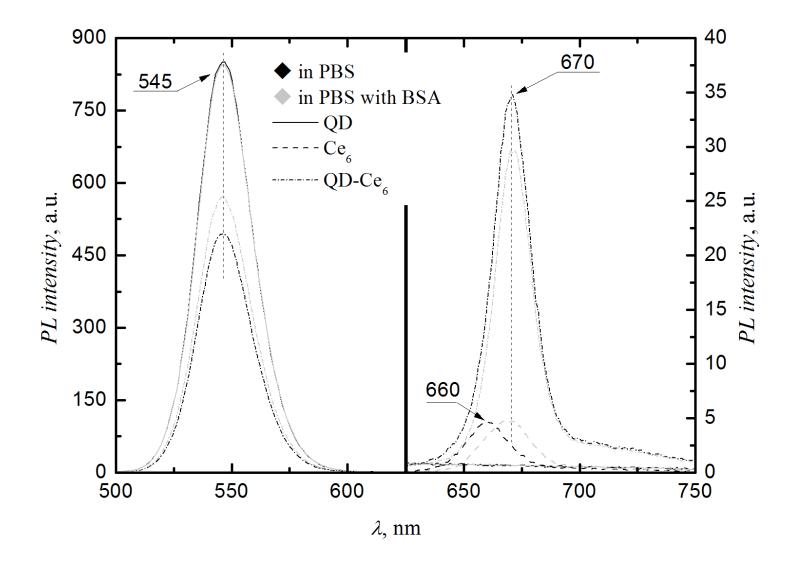
intensities of 545 nm and 670 nm bands in the emission spectrum were similar to those as in the case of adding BSA to already formed QD-Ce6 complex solution. Obtained fluorescence emission and excitation spectra indicates that QD-Ce6 complex still forms in the presence of BSA and can successfully undergo energy transfer.
We conclude that the photosensitizer Ce6 can form a stable complex with CdSe/ZnS-amino(PEG) quantum dots in the presence protein at studied concentrations. The energy transfer from QD to bound Ce6 molecules occur in the presence of BSA, however with lower efficiency.