
Nowadays electric motors are used everywhere: at home, on the street, at work. Although electricity has been known for more than 2000 years and an electric motor at least 200 years, their construction and materials are being improved continuously. Parallel Path Magnetic Technology (PPMT) is an advanced magnetic force control technology that is applicable to motors, rotary actuators, linear actuators, and generators. PPMT uses two or more permanent magnets positioned in parallel [1]. The basic magnetic circuit consists of a flux steering coil on each flux path. If there is no current in the coils, the magnetic circuit then acts as if the coils does not exist (Figure 1). However if current flows in the flux steering coils to produce a magnetic polarity, the magnetic flux produced by the coils couples with the permanent magnet's flux and the result is four units of force at one pole of the device (four units, not two, is due to the squared force law of the combined permanent magnet flux).
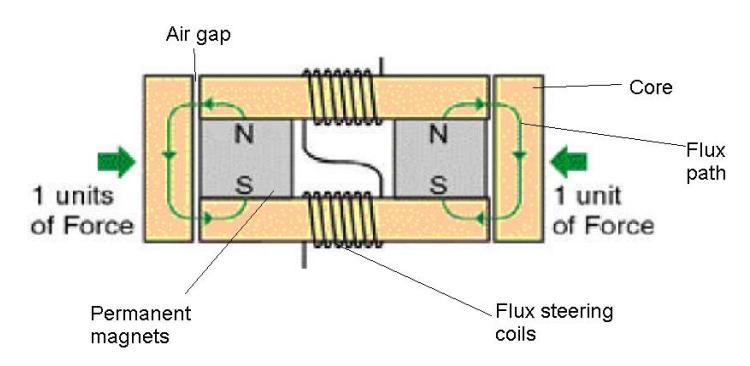
In our work the design for PPMT device is performed using finite- element (FE) analysis. This model is based on reduction of 3D problem to 2D problem which is considered as accurate for design aspects. In our research we describe theoretical, numerical and experimental model of PPMT device. Air gap magnetic flux density, field lines, vectors, saturation, magnetic force of the PPMT device are simulated using FEMM 4.2 software (Figure 2).
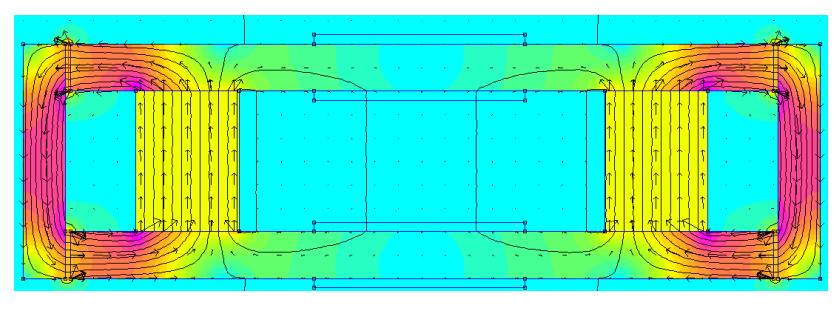
Approximate theoretical analysis was made for assessment of air gap magnetic field density using Circulation Theorem of magnetic field and Biot – Savart law. Magnetic force was calculated using Maxwell's stress tensor (Eq. (1)).
$$T_{ik} = \varepsilon_0 E_i E_k + \frac{1}{\mu_0} B_i B_k - \frac{\delta_{ik}}{2} \left( \varepsilon_0 \vec{E}^2 + \frac{1}{\mu_0} \vec{B}^2 \right), [N/m^2]\tag{1}$$
An experimental model of basic PPMT actuator is manufactured and tested in dynamo bench. Obtained experimental results are compared with output from analytical and numerical models.