FABRICATION OF MICROLENS ARRAYS BY DIRECT LASER WRITING
K. K. Tikuišis1, K. Belazaras1, E. Stankevičius2, M. Malinauskas1
1 Laser Research Center, Physics Faculty, Vilnius University, Saulėtekio ave. 10, LT-10223 Vilnius
2 Laboratory for Applied Research, Center for Physical Sciences & Technology, Physics Institute, Savanorių str. 231, LT-02300 Vilnius
Various microoptical devices allowing to guide and direct light are used nowadays. Those devices range from microlens, diffraction gratings to photonic crystals. Microlens are now fairly widely used in scientific research and industrial applications, although one can miss a detailed examination of their focusing properties, especially when nearing the nanoscale.
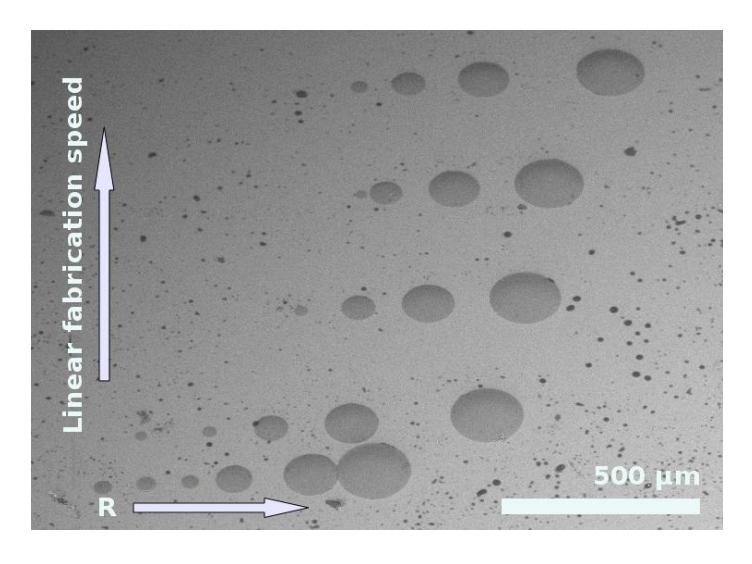
Here we present aspherical microlens arrays of various parameters (Fig. 1) fabricated by means of multi-photon polymerization technique, granting unrelevant flexibility of microsystems design. The arrays are made of hybrid organic-inorganic photoresist ORMOSIL (SZ2080, FORTH), chosen because of its high mechanical resistance and good optical properties.
Fig. 1. SEM micrograph of aspherical microlenses with various parameters fabricated by means of multi-photon polymerization.
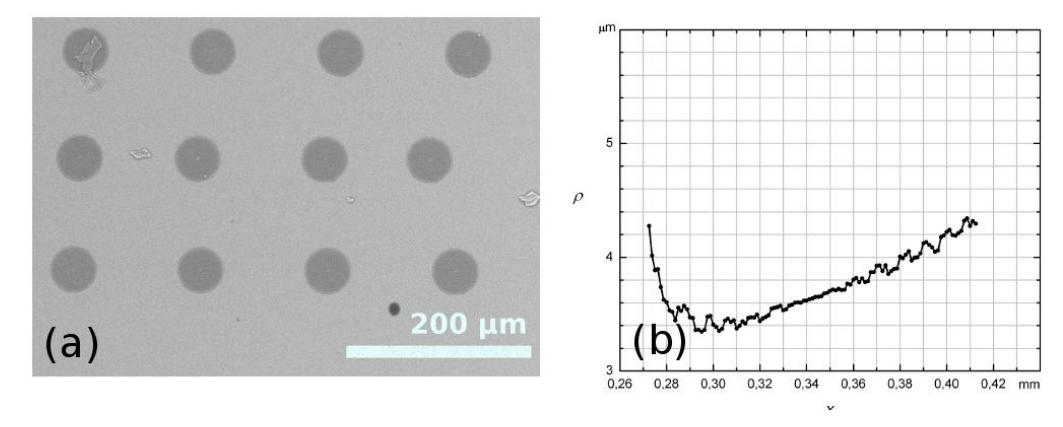
Microlenses with radii varying from 25 μm to 100 μm and linear translation speed ranging from 1000 μm /s to 1800 μm /s were successfully fabricated. Their focusing properties - specifically focal distance and beam waist radius - were examined (Fig. 2).
Fig. 2. (a) SEM micrograph of 25 μm radius aspherical microlens array. (b) Beam waist radius (ρ) vs distance from lens surface (x) of one selected microlens.
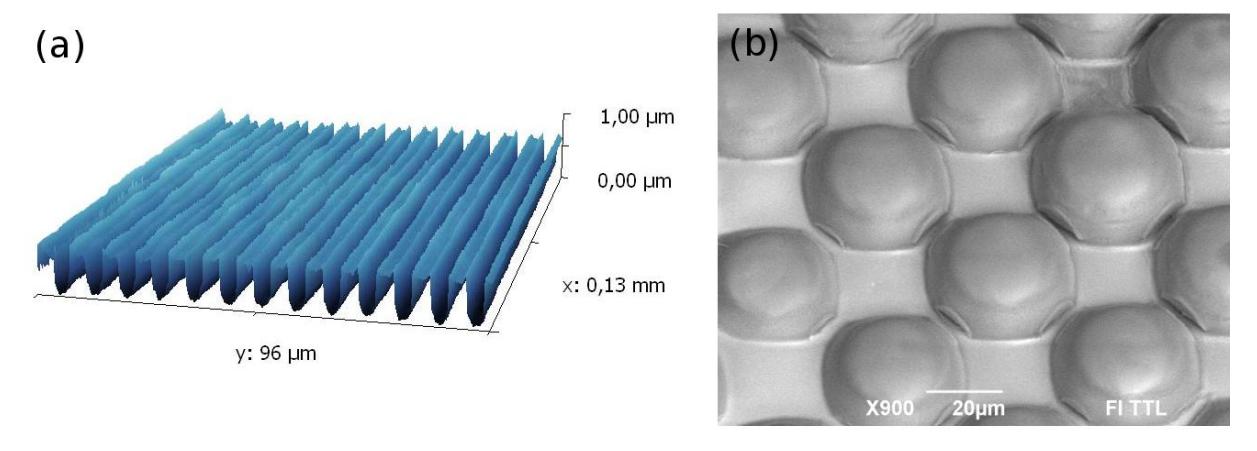
One of many possible applications of microlens arrays is their use for multibeam two-photon polymerization processing [2, 3], allowing to noticeably reduce fabrication time of repetitive structures and still employ an unprecedented flexibility of the technology. Here diffractive optical elements and microlens arrays made by interference polymerization technique (Fig. 3) are presented.
Fig. 3. (a) Surface topography of a diffractive optical element. (b) SEM micrograph of microlens array made by interference polymerization.
[1] M. Malinauskas, A. Zukauskas, V. Purlys, K. Belazaras, A. Momot, D. Paipulas, R. Gadonas, A.Piskarskas, H. Gilbergs, A. Gaidukevičiūtė, I. Sakellari, M. Farsari, S. Juodkazis, Femtosecond laser polymerization of hybrid/integrated microoptical elements and their characterization, J. Opt. 12, 124010 (2010).
[2] C. S. Lim, M. H. Hong, Y. Lin, Q. Xie, B. S. Luk'yanchuk, A. S. Kumar, M. Rahman, Microlens array fabrication by laser interference lithography for super-resolution surface nanopatterning, Appl. Phys. Lett. 89, 191125 (2006).
[3] R. Guo, D. Yuan, S. Das, Large-area microlens arrays fabricated on flexible polycarbonate sheets via single-step laser interference ablation, J. Micromech. Microeng. 21, 015010 (2010).