Every modern high-power ultrashort laser system involves pulse stretcher and compressor. Ultrashort pulses are initially stretched in time and after amplification, they are re-compressed with the help of the reversed dispersion compressor.
The aim of this work was to develop the compressor for ultrashort pulses derived from femtosecond oscillator and further amplified in an optical parametric amplifier. In order to obtain high stretch factor, it is necessary to use highly-dispersive SF 10 bulk glass stretcher. The compressor must compensate not only group velocity dispersion or GVD (that is introduced by dispersive material) but also the third order dispersion or TOD. If left uncompensated, leftover TOD will prevent the pulse from being compressed to its transform-limited duration.
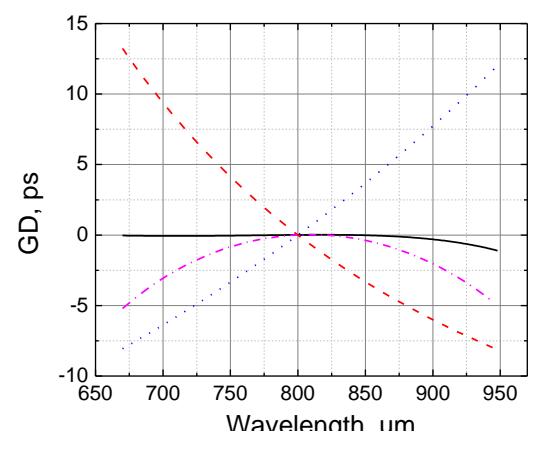
A compressor consisting of grating and prism pairs has been modeled. For any configuration of a grating compressor, the GVD is always negative and the TOD is always positive. However, a prism pair produces negative GVD and negative TOD and can be used complementary with a pair of gratings. The results of output pulse group delay or GD modeling are depicted in fig. 1.