The lack of appropriate waste management is currently one of the major environmental concerns of the world. An average citizen of a developed country produces annually 300 kg of waste that is mostly disposed on landfills. The population is growing and so is the amount of produced wastes. It is therefore crucial to shift from waste disposal to more sustainable waste management methods. By means of the recent directive on waste (2006/12/EC) the European Council encourages the Member States to reduce the waste production by developing clean technologies and to enhance changes in current waste management, especially by introducing "the recovery of waste by means of recycling, re-use or reclamation or any other process with a view to extracting secondary raw materials or to make use of waste as a source of energy" [1].
One of the methods of dealing with organic waste is to convert it into a flammable gas by means of anaerobic digestion or thermal gasification. Thermal gasification is a complicated physicochemical process that takes place in reducing (oxygen-deficient) environment and requires heat. The object of this paper is to present the process taking place in an up-draft air gasifier and briefly discuss its chemical aspects.
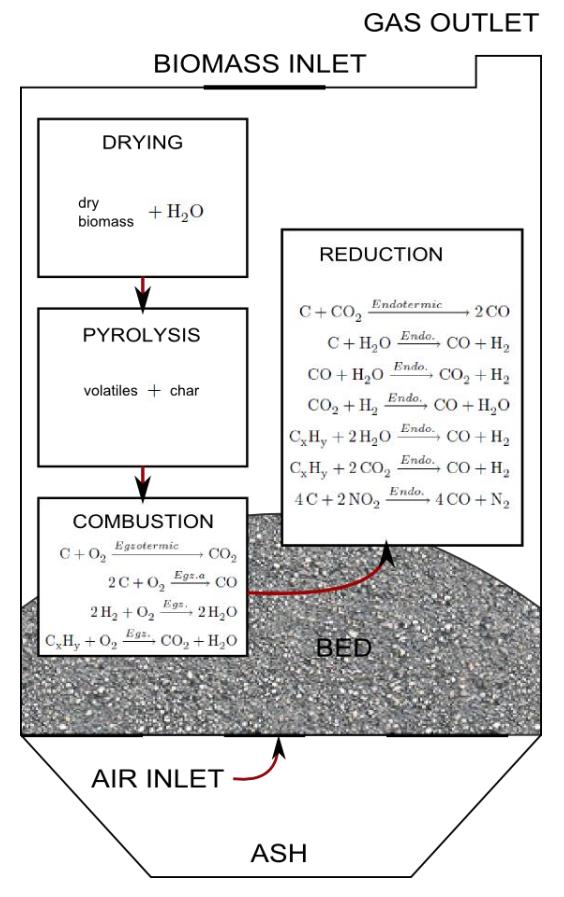
The process consists of four distinct phases, which are: drying, pyrolysis, combustion and reduction (actual gasification). Though there is a considerable overlap between those phases, it can be assumed for the purpose of modelling that each of them occupies a separate zone of the gasifier, where fundamentally different chemical reactions take place [2]. The final product of the process is a flammable gas consisting essentially of N2, H2, CO, CH4.
In the first zone the biomass dries. Wood, which is the most common substrate for the process, usually consists of about 10 – 60 % water. The following process is pyrolysis which is a thermal decomposition of the organic compounds in absence of oxygen. At common gasifiers the process takes place in temperatures from 500 to 700°C and is driven by the energy released during the combustion of the previous load of biomass. The chemistry of the process is not well understood [4]. The products of the decomposition are in three phases: solid (char), liquid (tar – gaseous at the process conditions, liquid after cooling to 25°C) and gaseous (CO, CO2, H2 and CH4).
The third phase is combustion when the char is partially oxidized according to the formulas (1) and (2), releasing energy:
$$C + O2 = CO2 (+ 393 \text{ MJ/kg mole})\tag{1}$$
$$2H2 + O2 = 2H2 O (-242 MJ/kg mole)\tag{2}$$
Finally the gasous products of the previous processes and the hot char react in the reduction phase according to the formulas (3), (4), (5), (6) and (7):
$$C + CO2 = 2CO (-164.9 \text{ MJ/kg mole})\tag{3}$$
$$C + H2O = CO + H2 (-122.6 \text{ MJ/kg mole})\tag{4}$$
$$CO + H2O = CO + H2 (+ 42 \text{ MJ/kg mole})\tag{5}$$
$$C + 2H2 = CH4 (+ 75 MJ/kg mole)\tag{6}$$
$$CO2 + H2 = CO + H2O (-42.3 \text{ MJ/kg mole})\tag{7}$$
The spacial configuration of the above described phases in an up-draft gasfier is presented in the figure 1 [3].