Zinc oxide (ZnO) is a promising material for modern optoelectronics. Recently interest in investigation of ZnO and ZnO-based structures increased essentially due to achievements in growing technology of high quality of quantum-size structures along with unique electrical, optical and crystal structure properties of ZnO itself. It is important not only for industry, medicine and other industries, including novel optoelectronic devices, but for fundamental investigation, too. The oneness of ZnO among other semiconductors is due to large direct energy gap, which ranges from 3.44 to 3.38 eV in temperature interval from 0 to 300 K, and unusually large (60 meV) exciton binding energy. These properties make ZnO a promising material for optoelectronics and are almost ideal for LEDs and laser diodes operating in the blue and near ultraviolet spectra region.
In this paper, various interactions of excitons responsible for optical properties of material are taken into consideration. Usually, inelastic interactions of excitons are very important for optical properties including luminescence mechanisms in highly excited crystal, when colliding excitons annihilate eradiating photons and break down into pairs of electrons and holes, or moves to higher kinetic energy and/or higher excited states. The various possible interactions determine the properties of different fluorescent lines: different peak position and shape of distribution of luminescence spectra. In order to correctly determine the nature of the luminescence all kinds of interaction between excitons have been taken into account.
The excitonic luminescence intensities maxima are shifted from ground state of free exciton to lower energy side by $E_b$, $\frac{3}{4}E_b$, $\frac{1}{2}E_b$ and $0E_b$ respectively for these interactions (Fig. 1): a) $(E_{1s}^{K}, E_{1s}^{K'}) \to (\hbar\omega, e-h)$, b) $(E_{1s}^{K}, E_{2s, 2p'}^{K'}) \to (\hbar\omega, e-h)$, c) $(E_{1s}^{K}, E_{1s}^{K'}) \to (\hbar\omega, E_{2s, 2p''}^{K''})$ and d) $(E_{1s}^{K}, E_{1sK'}) \to (\hbar\omega, E_{1sK''})$.
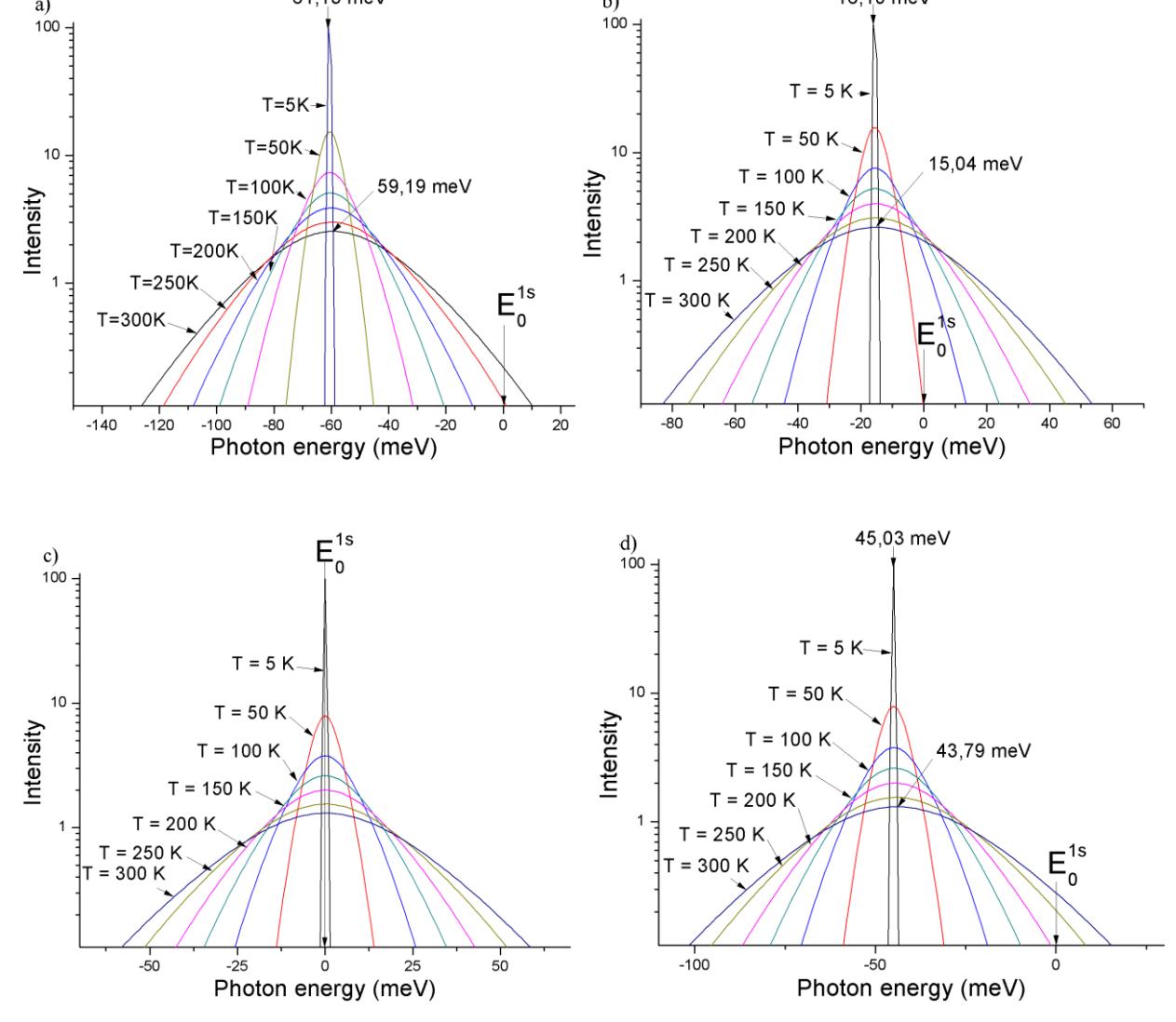
At low temperatures, interactions of excitons form narrow luminescence lines, but increase of temperature leads to broadening of these lines and shift of their maxima, except for interaction $(E_{1s}^{K}, E_{1s}^{K'}) \rightarrow (\hbar\omega, E_{1s}^{K''})$.
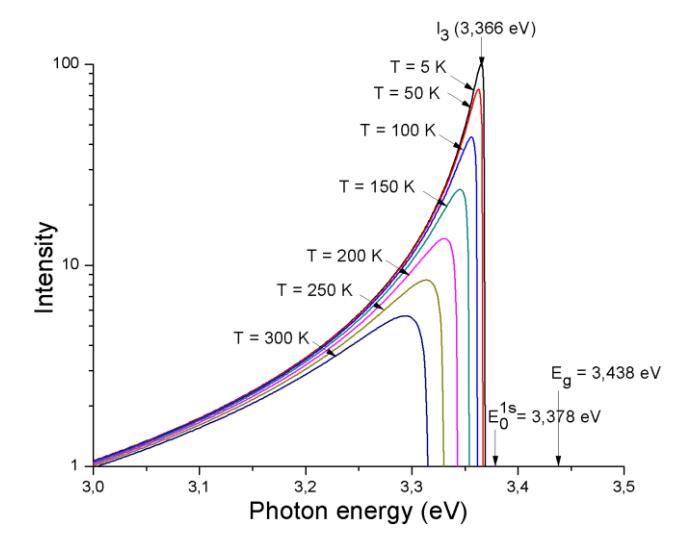
We suggest e new luminescence mechanism of exciton collisions, namely interaction between free and localized excitons. Interaction of localized exciton with a free exciton at low temperatures forms a narrow line, which broadens rapidly when the temperature is increased (Fig. 2).