
Proton-beam irradiation is a prospective technique for modifying the electrical properties of silicon crystals [1]. One of the most interesting properties of implanted hydrogen is that its interaction with radiation induced and native defects during heat treatment leads to the formation of shallow hydrogen-related donors (H-donors) [2].
In our studies we used commercial Pd-Si Schottky diodes. The diodes were implanted with 300-keV H+-ions at room temperature. The dose varied in the range F = $(1\times10^{13} - 1\times10^{15})$ cm-2. The electron concentration profiles were obtained by C–V (voltage-capacitance) measurements at a bridge frequency of 1.2 MHz. The parameters of radiation-induced defects were determined by deep level transient spectroscopy (DLTS) at 1 MHz and a gating time ratio $t_2/t_1$ = 5.
Changes of the depletion region width (reverse bias U=-5 V, temperature T=86 K) and dependence of radiation-induced defects concentration from isochronal (20 min) annealing temperature are presented in Fig. 1. DLTS spectra are shown in Fig. 2. Values of parameters of post-implantation radiation defects (a curve 1) are found using Arrhenius plots. These parameters are used for identification of defects (according to data [1])
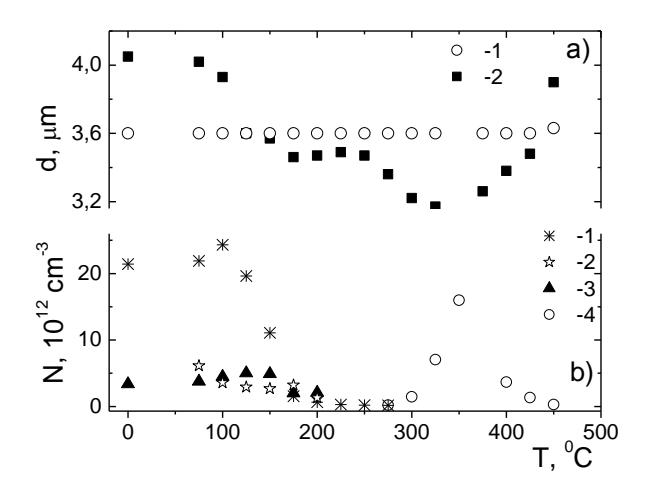
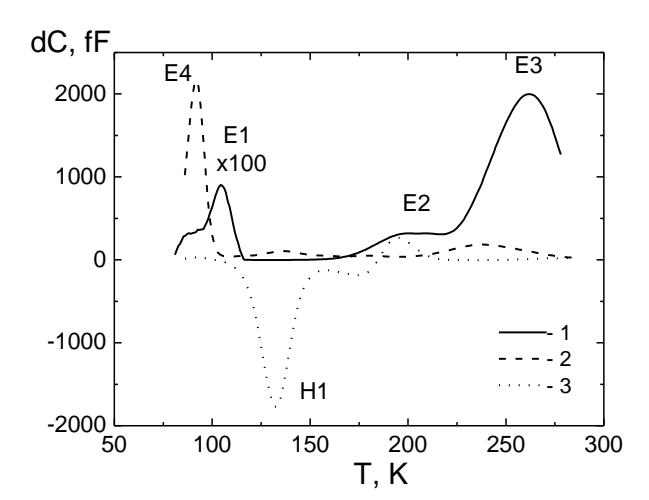
The depletion region width before implantation was $d=3.6$ μm. According to the comparative analysis of the obtained data (Fig. 1), increasing of $d$ up to 4 μm is generally caused by formation E-center (curve 1), because concentration of A-center and VOH defect (curves 2, 3) are negligible (E-center – defect donor-vacancy, A-center – defect oxygen-vacancy, VOH – defect vacancy-oxygen-hydrogen). After E-center annealing at $T=200$ °C $d$ restores to initial value. At the further rising of annealing temperature quantity $d$ becomes below initial value. This fact indicates of donors' formation. Their maximum concentration is reached at $T=350$ °C and it coincides with concentration of undefined defect E4 (energy level Ec-0.21 eV and electron capture cross-section $\sigma=2\times10^{-11}$ cm2) in Fig. 2 (curve 2). At the temperature $T=450$ °C the depletion region width exceeds the initial value, and anomalous peak (a minority carriers trap in the absence of hole injection) appears in DLTS spectrum (curve 3). This peak corresponds to acceptor center H1 (energy level Ev+0.31 eV), and their concentration is approximately equal to concentration of E4 defect.
Thus we can see relationship between radiation defects and donors in silicon. After annealing of radiation defects (such as E-center, A-center, VOH defect) we observe formation of H-donors. After annealing at 350 °C we observe maximum concentration of donors, and it corresponds to maximum concentration of E4 defect. Subsequent annealing leads to the disappearance of E4 defect and reduce the concentration of donors.