
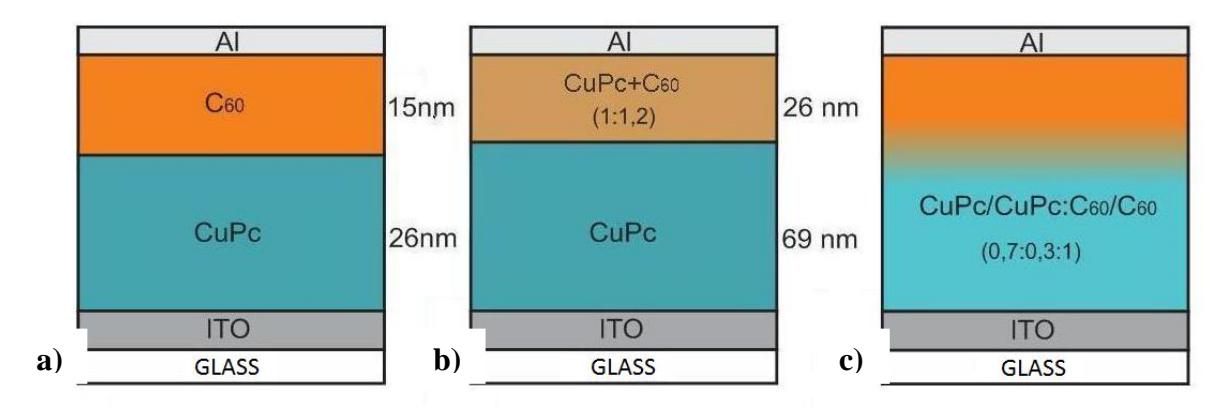
Organic layers of CuPc and C60 followed by solar cells of different structures (Fig. 1) were formed by vacuum deposition onto by ITO covered glass substrates: two layer CuPc/C60 (Fig. 1a), two layer with mixture CuPc/CuPc+C60 (Fig. 1b), gradient mixture CuPc:C60 (Fig. 1c) solar cells. Their absorption spectra and photoelectric feauture dependence on annealing and various C60 and CuPc ratios in mixtures was investigated.
Carrier mobility $μ$ dependences on electric field $E$ and carrier lifetimes $τ_{1/2}$ were measured by photo-CELIV (charge extraction by linearly increasing voltage) technique [2].
Estimated CuPc hole drift mobility and carrier lifetime $μ = 3 \cdot 10^{-8}$ cm2/Vs, $τ_{1/2} = 48$ ms; C60 electron drift mobility and carrier lifetime $μ = 2\cdot 10^{-5}$ cm2/Vs, $τ_{1/2}= 200$ μs. 60 min 100°C annealing of CuPc had no effect on hole transport but C60 electron transport was enhanced: $τ_{1/2} = 430$ μs and $μ$ having weaker dependence on $t_{d}$ ($t_{d}$ is the delay between the light pulse and the linearly increasing voltage pulse), which may be explained by formation of a more favorable C60 molecule arrangement after annealing that is confirmed by the absorption spectra.
Estimated hole drift mobility $μ = (3,5 - 7,5) \cdot 10^{-8}$ cm2/Vs of CuPc/C60 sample exhibits a weak dependence on the applied electric field which may attributed to the formation of CuPc and C60 heterojunction that affects the electric field distribution inside the sample. Two layer solar cell was fabricated, which demonstrated $η_{eff} = (0.36 - 1.05)$ % efficiency (compared to CuPc (20 nm)/C60 (40nm)/ BCP (2 nm) $η_{eff} = 0,75$ % [1]).
Samples of CuPc/CuPc+C60 structure demonstrated electron drift mobilities $μ = (1 - 5) \cdot 10^{-6}$ cm2/Vs which were mildly enhanced by 60 min 100°C annealing $μ = (2,5 - 6) \cdot 10^{-6}$ cm2/Vs. The latter can be attributed to a formation of a more energetically favorable CuPc and C60 mixture which is confirmed by the increase of absorption in 400 - 600 nm range.
In samples of gradient mixture CuPc:C60 solar cells estimated electron drift mobility was $μ = (9 \cdot 10^{-6} - 1 \cdot 10^{-5})$ cm2/Vs, which is close to pure C60 electron drift mobility. After 60 min 40°C + 60 min 80°C annealing the electron drift mobility dependence on $t_{d}$ was sufficiently increased, which may be explained by a formation of bulk heterojunction. The latter is confirmed by the increase of current in current voltage characteristics and electron lifetime decrease: $τ_{1/2} = 280$ μs, after annealing $τ_{1/2} = 100$ μs.