
An improvement of lightning technologies is a great challenge for scientists and engineers, as it has a direct impact on everybody's life. Good source of light should be effective, small, cheap and should have long lifetime, together with low price. Light emitting diode (LED) is the most efficient light emitting device that can be used nowadays. ZnO is excellent candidate for LEDs, because it poses perfect optical properties, high mechanical stability, piezoelectric features and, most important for LEDs, possibility to grow nanostructured ZnO using simple growth techniques on cheap substrates [1]. Aqueous chemical growth (ACG) is excellent technique for nano-ZnO growth. It requires low temperatures, ordinary chemicals and simple substrates without any need of special treatment [2]. The only drawback of ZnO is poor quality of p-type layers. This problem is solved by using hybrid inorganic-organic semiconductor heterostructures of n-ZnO and p-type organic semiconductor. Organic semiconductors can be easily doped and they can be easily introduced into various semiconductor structures.
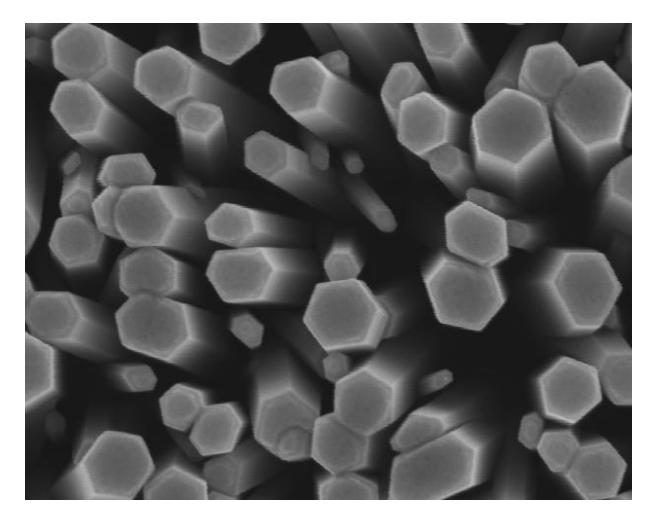
In this work, we report on growth and characterization of hybrid ZnO white LEDs on plastic substrate. Nanostructured ZnO nanorods (see fig. 1) of 2 – 3 mm length and average 150 nm diameter were grown utilising ACG method on the top poly (3,4-ethylenedioxythiophene) poly-styrenesulfonate (PEDOT:PSS) and poly (9, 9-dioctylfluorene) layer system. Detail growth steps are described in ref. 3.
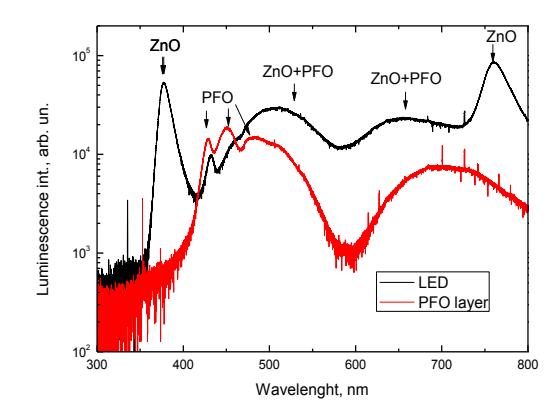
PEDOT:PSS layer is used as an electrode and PFO is used for the light emission at blue-green range. White light in ZnO LEDs is being produced by mixing blue-green-red light from PFO layer and UV, blue and red light from ZnO nanorods (see fig. 2). The usage of PFO layer improves the intensity of light emission in visible range.
Room temperature electroluminescence spectra (not shown here) consist of three bands at 448, 469 and broad band at about 541 nm. Calculated colour rendering index (CRI) and correlated colour temperature of white ZnO LEDs were calculated 68 and 5800 K [3].
In this work, a model of hybrid ZnO based white LED on flexible plastic substrate was demonstrated. The quality of white light is described by the CRI index of 68, which later can be improved by tuning spectral properties of LED.