REPLICATION OF MICRO/NANOSTRUCTURES USING POLYDIMETHYLSILOXANE SOFT LITHOGRAPHY
E. Balčiūnas1, 2, 3, S. Rekštytė1, L. Jonušauskas1, M. Malinauskas1
1 Laser Research Center, Department of Quantum Electronics, Vilnius University, Saulėtekio Ave. 10, LT-10223 Vilnius, Lithuania
2 Vivarium, Institute of Biochemistry, Vilnius University, Mokslininkų 12, LT-08662 Vilnius, Lithuania
3 Department of Chemistry and Bioengineering, Faculty of Fundamental Sciences, Vilnius Gediminas Technical University, Saulėtekio ave. 11, LT-10223 Vilnius
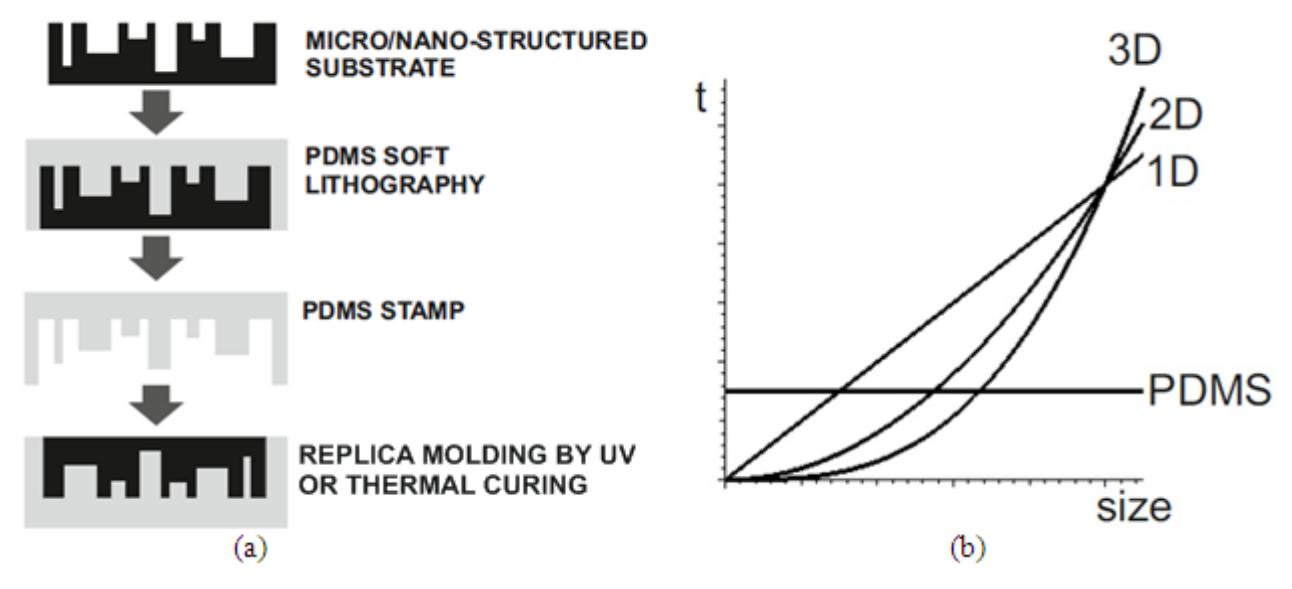
With the growing need for micro and nano-scale objects, fabrication methods that are low cost, high throughput and simple to operate are in an increasing demand. We present replica molding by PDMS (polydimethylsiloxane) soft lithography (Fig. 1 (a)).
Fig. 1. (a) - schematics of micro/nano-structured object replication using PDMS; (b) Replication by PDMS soft lithography is independent of structure dimensions, because it is cured all at once. Fabricating a structure using multi-photon polymerization requires time consuming serial writing.
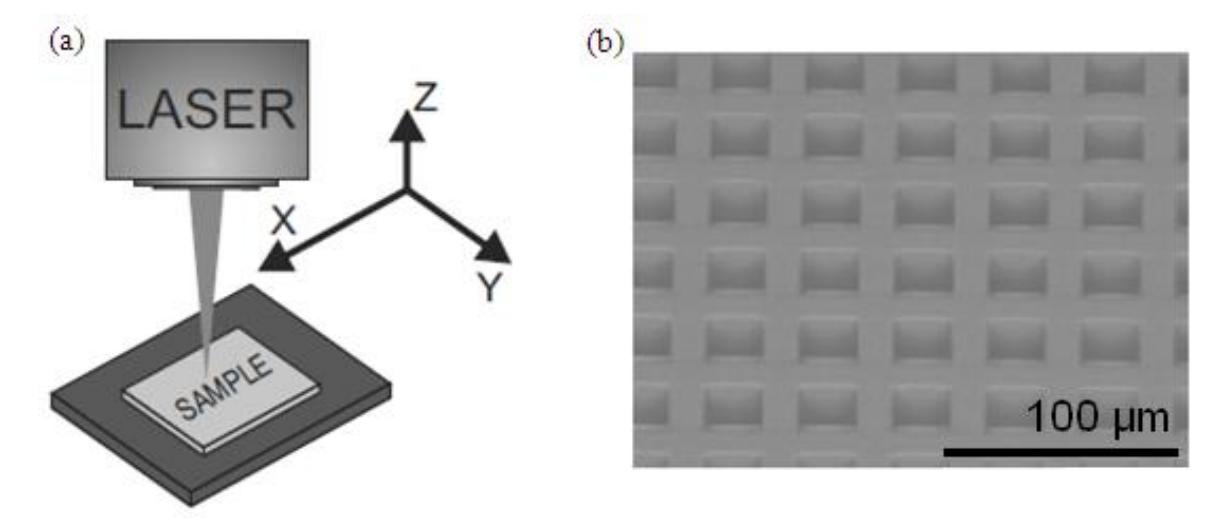
Compared to other fabrication techniques, like laser multi-photon polymerization (Fig. 2 (a)), PDMS soft lithography is attractive because of its area (volume) – independent fabrication time (Fig. 1 (b)) and a relatively low cost/quality ratio.
PDMS is a substantial elastomer and stamps made of it may be used up to a thousand times without significant loss of quality. It also allows usage of new materials, that would otherwise not be susceptible to structuring, e.g. PEG-DA (poly (ethylene glycol) diacrylate).
Fig. 2. (a) - The principle of direct-laser writing using multi-photon polymerization. (b) – SEM micrograph of a scaffold out of SZ2080 photopolymer, fabricated using multi-photon polymerization.
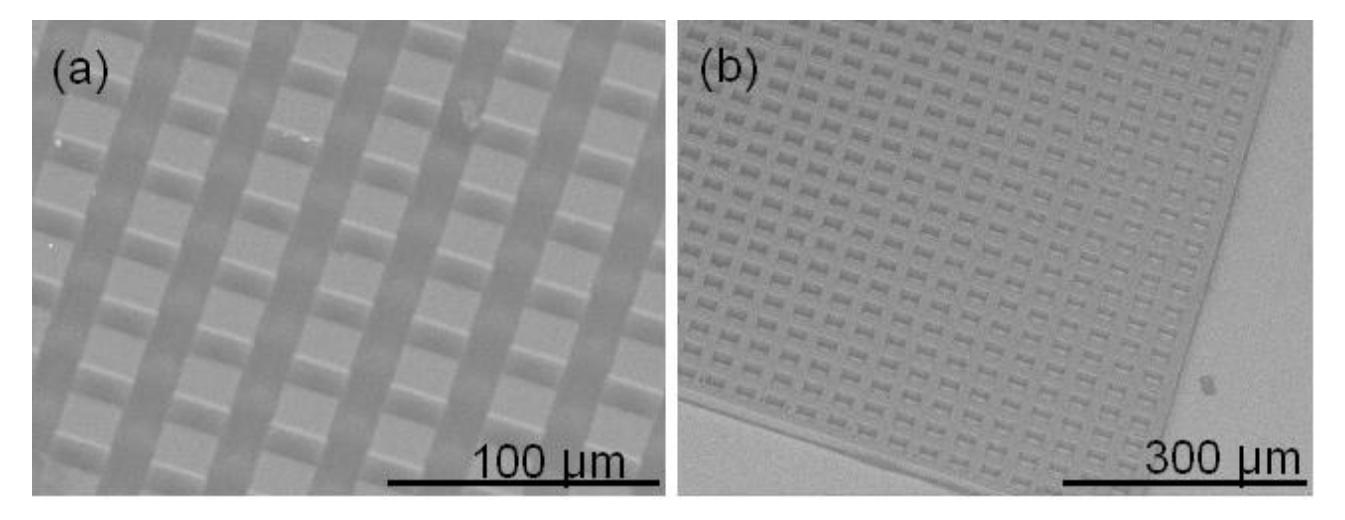
We have successfully replicated scaffolds for stem-cell growth (Fig. 3 (b)), reducing fabrication time twentyfold, as well as elements of micro-optics.
Fig. 3. (a) – a PDMS stamp, made using a SZ2080 master . (b) – a replica of the laser fabricated SZ2080 scaffold, made of PEG-DA-258 polymer.
There is a wide spectrum of other applications which would benefit from this replica molding technique, such as microfluidics, photonic components, plasmonic metamaterials, etc.
[1] M. Malinauskas et al., Large Scale Laser Two-Photon Polymerization Structuring for Fabrication of Artificial Polymeric Scaffolds for Regenerative Medicine, Proc. AIP 1288, 12-7 (2009).
[2] M. Malinauskas et al., Femtosecond laser polymerization of hybrid/integrated micro-optical elements and their characterization, J. Opt. 12, 124010 (2010).
[3] G. Kumi et al., High-speed multiphoton absorption polymerization: fabrication of microfluidic channels with arbitrary cross-sections and high aspect ratios, Lab Chip 10, 1057-60 (2010).