
Analysis of electronic excitation dynamics is important in order to understand the efficiency of excitation energy transfer (EET) in wide variety of molecular complexes including photosynthetic pigment-protein membrane aggregates [1]. Redfield theory is commonly applied for studying dissipative electronic excitation dynamics. However, because of its perturbational nature and Markovian approximaton, the Redfield theory is limited to weak coupling between the system and the environment. While these limitations pose no problems in most applications, it has been shown that there are cases when the Redfield theory is not suitable [2].
Hierarchical equation of motion (HEOM) theory [3] is a nonperturbational theory and it allows going beyond the Markovian regime. However, the full HEOM theory is very expensive computationally and is usually applied only for small systems: monomers and dimers. In this work, we utilize a simpler version of HEOM, named Hierarchical quantum master equation (HQME), which has an impressive applicability range but much lower computational cost [4].
Here we analyze electronic excitation dynamics in a molecular dimer using HQME, with a set of parameters typical to photosynthetic EET. Time evolution of the population of the lowest energy exciton state (denoted $\rho_{e1e1}$) is presented in Fig. 1. Here $\lambda$ denotes electron-phonon coupling strength whereas $J$ denotes intermolecular coupling strength.
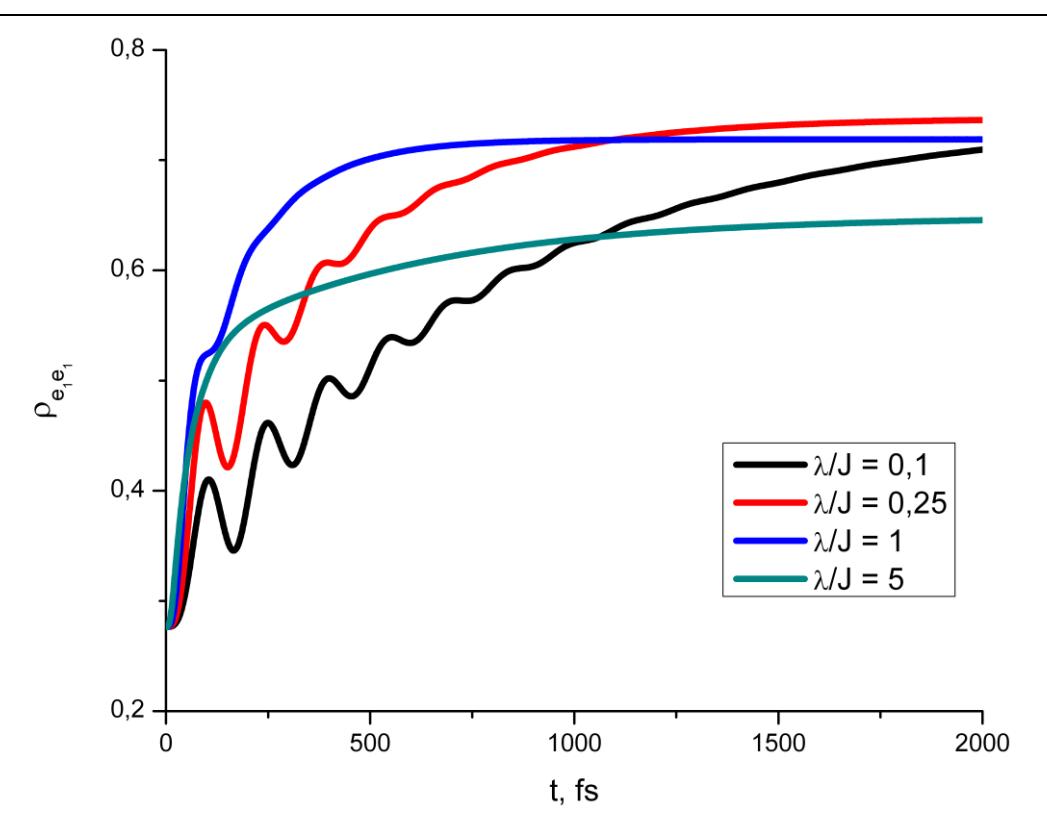
First, it should be noted that, when electron-phonon coupling is not very strong, oscillations in population dynamics can be observed. These oscillations show influence of electronic coherence to population dynamics. The aforementioned oscillations last for relatively long times.
Second, it can be seen that electron-phonon coupling strength strongly influences relaxation rates. The data in Fig. 1 shows that population of the lowest energy exciton state relaxes to equilibrium faster, when $\lambda = J$. The rate of relaxation decreases, however, when electron-phonon coupling strength is relatively weaker or stronger than intermolecular coupling strength.
Finally, as can be seen from Fig. 1, the equilibrium distribution in the dimer depends on electron-phonon coupling strength. It can be shown that increasing $\lambda$ lowers the difference between the energies of the dimer eigenstates. This corresponds to effective decrease of intermolecular coupling strength due to electron-phonon coupling.