
The aim of this work is to measure and compare the variation of the recent activity concentrations of three radionuclides - cosmogenic Be-7, artificial Cs-137 and terrestrial Pb-210 – in the near-ground level atmosphere at two different sites– in the Ignalina Nuclear Power Plant (further - INPP) impact zone (3.5 km southeast of the INPP) and in Vilnius - and to estimate how these radionuclides contribute to the annual committed effective dose for the members of public.
The measurements of the activity concentrations were carried out using gamma-spectrometers with HPGe detectors for the non-destructive analysis of FPP-15 filters. The filters used in Vilnius (sampling time – 2 weeks) were analysed using a well-type detector and the ones from the INPP impact zone (sampling time – 1 week) were analysed using a coaxial detector. Three peaks of the gamma-ray spectra were analysed: 46.5 keV (Pb-210), 478 keV (Be-7) and 661.7 keV (Cs-137).
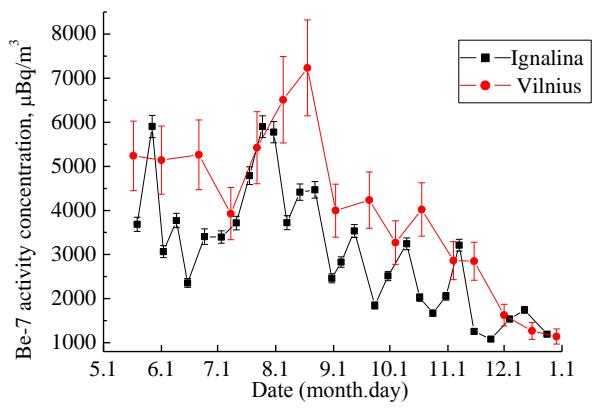
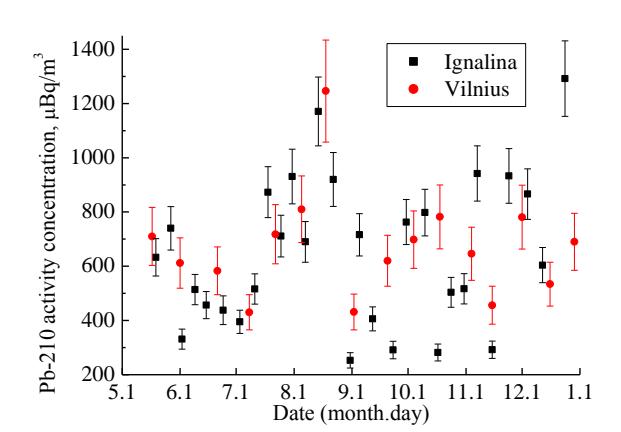
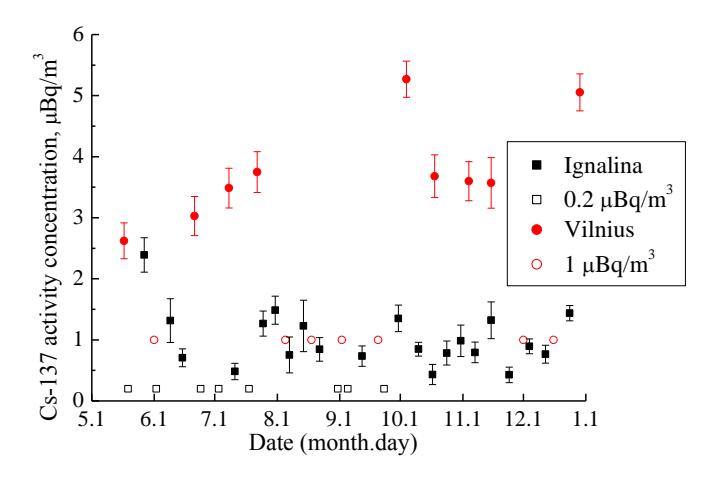
The variations of the Be-7, Pb-210 and Cs-137 activity concentrations in Vilnius and in the INPP impact zone from May to December 2010 were measured and the results are shown in figures 1, 2 and 3, respectively. The vertical dashes in the figures denote the 68% confidence intervals. Assuming that the radionuclides get into the human (adult) body via the inhalation pathway and the mean breathing rate is 6.5 l/min, the contribution of each radionuclide to the annual committed effective dose was estimated. The results are shown in Table 1.
| Nuclide | Conversion coeff. [Sv/Bq] | Vilnius | The INPP impact zone | ||
|---|---|---|---|---|---|
| Activity conc. [Bq/m3] | Effective dose [Sv] | Activity conc. [Bq/m3] | Effective dose [Sv] | ||
| Be-7 | 5.5 E-11 | 4.0 E-03 | 7.5 E-10 | 3.1 E-03 | 5.9 E-10 |
| Cs-137 | 3.9 E-08 | 2.6 E-06 | 3.4 E-10 | 7.9 E-07 | 1.1 E-10 |
| Pb-210 | 5.6 E-06 | 6.7 E-04 | 1.3 E-05 | 6.5 E-04 | 1.2 E-05 |
The activity concentrations of Be-7 in Vilnius and in the INPP impact zone are highest in July and August because of the tropopause changes in spring [1].
The Cs-137 activity concentrations in both sites represent the global distribution of this radionuclide.
The activity concentrations of Pb-210 in both sites are similar with a mean value of 660 μBq/m3. These are typical for the continental locations.
The annual committed effective dose for the members of public due to Pb-210 makes up about 1.2 - 1.3% of the annual limit effective dose (1 mSv). The annual committed effective doses for the members of public due to Be-7 and Cs-137 are insignificant.