
The life evolved on Earth strongly depends on the sunlight harvesting occurring in all photosynthetic organisms. In green plants the light reaction of photosynthesis is related to the photosystem II – the huge pigment-protein supercomplex located in the thylakoid membrane in the chloroplasts. Structurally it consists of the light-harvesting antenna, where the major part of the chlorophyll (Chl) molecules can be found, and the reaction centers, to which the excitation energy from the antenna is finally transfered, initiating the process of charge separation.
Another physiologically important process also related to the light-harvesting antenna is a very effective regulation of the amount of the absorbed light energy. At high light intensity not all the energy of the absorbed photons can be used in photochemical reactions, which can result in the production of the singlet oxygen – a very strong oxidant which can damage the whole photosynthetic unit. In order to avoid such a photodamage, plants have developed several protective mechanisms. One of them, acting on the molecular level and dissipating the excess energy as heat, is known as non-photochemical quenching (NPQ) and, as was recently shown in the time-resolved spectroscopy measurements [1], takes place in the major light-harvesting complexes (LHCII). It is commonly agreed that the increasing intensity of the sunlight causes some configurational changes within the LHCII which lead to the generation of additional excitation trapping centers (probably related to the carotinoid molecules) converting the excess excitation energy to heat. However, despite recent extensive studies in this field and several suggested models, a common consensus about the origin of the NPQ-traps has not been achieved so far.
Since experimentally observable excitation decay kinetics in the LHCII aggregates under NPQ conditions are mostly bi-exponential, there are 2 principle ways to qualitatively describe such results [2]. In the 'migration-limited' case the excitation slowly migrates through the antenna until it reaches the NPQ-trap, and then quickly relaxes (the so-called slow/fast (SF) regime). In the converse 'trap-limited' regime the excitation lifetime is dominated by the trapping in the NPQ-center, whereas the migration can be assumed to be relatively fast.
In order to determine the key parameters defining the excitation kinetics and thus to get an insight into the origin of the NPQ, in the present work the excitation energy transfer and quenching in LHCII aggregates was considered in terms of a coarse-grained model, in which
only the transfer of excitons between separate pigment–protein subunits is treated explicitly, with all intra-monomer kinetics 'integrated out' of the calculation (Fig. 1). Excitation dynamics in such a system can be calculated by solving the Pauli master equations [3]
$$\frac{\mathrm{d}p_{i}}{\mathrm{d}t} = \sum_{j \neq i} (k_{ij} p_{j} - k_{ji} p_{i}) - k_{\mathrm{dis}} p_{i} - \delta_{i,\mathrm{NPQ}} k_{\mathrm{NPQ}} p_{i}, \quad i, j = 1, ..., N\tag{1}$$
where $p_i$ is the time-dependent probability for the excitation to be found in the ith complex; $k_{ij}$, $k_{\mathrm{dis}}$ and $k_{\mathrm{NPQ}}$ stand for the rates of the transfer from the jth to the ith complexes, intrinsic dissipation processes or non-photochemical trapping, respectively.
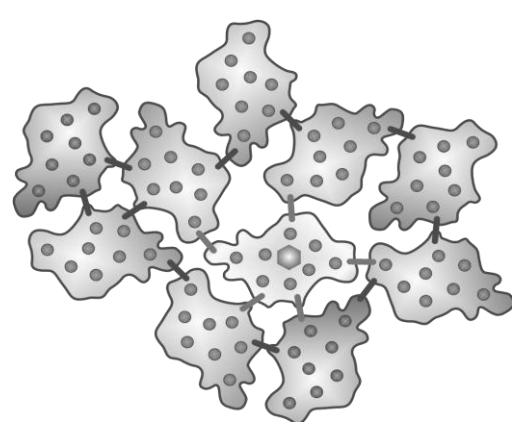
As follows from the calculations, this model can be well-fitted to the experimental kinetics assuming different values for the excitation hopping rate between different LHCII monomers. However, certain problems are encountered while assuming FS regime: the LHCII aggregate should be rather small, and excitation will be mainly localized on the NPQ-trap. Moreover, if considering NPQ excitation dynamics at higher excitation conditions when singlet–singlet annihilation starts to dominate, in the FS regime the excitation kinetics of the aggregate are almost insensitive to the initial excitation density. Conversely, the excitation kinetics in the SF regime display strong sensitivity to the changes in excitation density. Since the experimentally observed kinetics reveal a similar dependence, it can be concluded that the SF regime is a more appropriate description for the physical origin of the NPQ-trap: the excitation dynamics is mainly determined by the excitation migration within antenna, whereas the relaxation in the NPQ-center takes just several ps.