
Future molecular-scale devices and active mediums for holographic memories will rely on the level of fundamental understanding of the various molecular light-induced processes and the availability of subtle organic synthesis strategies, that could provide systems with the necessary physical properties. Photochromic (featuring changes in absorption due to irradiation by light) compounds, are among the best candidates for the aforementioned applications. Recently, a new class of such compounds, based on the light induced reversible opening of the indolo-benzoxazine heterocycle, was discovered [1;2] and investigated thoroughly. They exhibit excellent fatigue resistance, back-conversion lifetimes of tens of nanoseconds and have shown to support various structural modifications, that enable engineering of various electronic, chemical and optical properties.
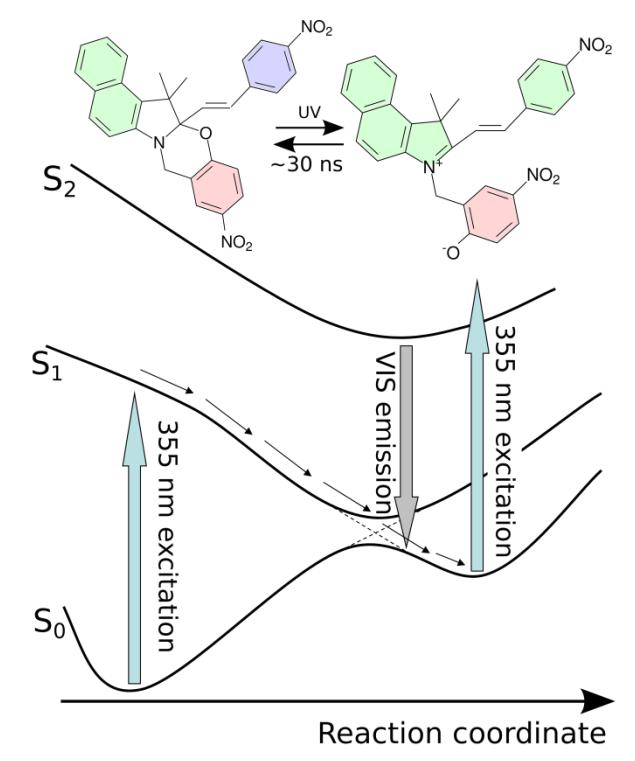
Here, we present an interesting group of molecules from the indolo-benzoxazine family, that develop absorbance in the visible region when exposed to UV light (Fig. 1). Two of them can be used as a short-lived (tens of nanoseconds) light-gated efficient fluorophores. After the UV light induced bond breaking of the oxazine cycle and the subsequent structural rearrangement, the conjugated systems of a benzoindole and a bromobenzene (or a nitrobenzne) groups become connected by a newly formed double bond in the indole moiety. This ring-opened form of the molecule feature an increased fluorescence quantum yield compared to the ring-closed form. Thus, for ca. 30 ns any subsequent excitation of the molecule will result in a broadband VIS emission. In the presented investigation this property is experimentally observed due to relatively long duration of 5 ns of the 355 nm wavelength excitation pulse – the same pulse forms and excites the ring-opened form (see Fig. 1).
It was also found, that a simple superposition model explaining the nature of the induced visible absorption spectrum, can only be applied to certain limited group of the indolo-benzoxazine compound family and in our case cannot account for one of the observed absorption peaks at all. More advanced techniques are thus required to gain a deeper understanding of the light-induced processes observed and few experimental directions to be taken next are suggested.