
The researches of thermoemitters are relevant because nowadays they are the main element in the microwave devices. The best parameters of these devices are achieved when using Sc metal dispensed emitters (MDE). However, to date there is no clear theory for explanation of the mechanism of the emission for such emitters. Despite the fact that already received a lot of experimental results there is a series of questions, which need to find the answer. One of them is the possible dependence of the emission possibility of the emitters from its structure (needle-shaped formation of the active substance or thick layers of this substance on tungsten matrix) and the composition of the emitting surfaces. So investigation of formation of nanostructures of alkaline earth metals oxides on scandium oxide and development of the model of crystal grow on its surface is relevant.
The researches were carried out in ultra high vacuum chamber at the pressure that does not exceed 6.8·10-7 Pa. There was an Auger analyzer type cylindrical mirror to analyze the composition of the surface. As a substrate compressed mixture of tungsten powder with submicron grains of Sc2O3 powder was selected. Activated 2.4BaO×0,6CaO×Al2O3 MDE was used as a source of Ba, BaO and Ca components.
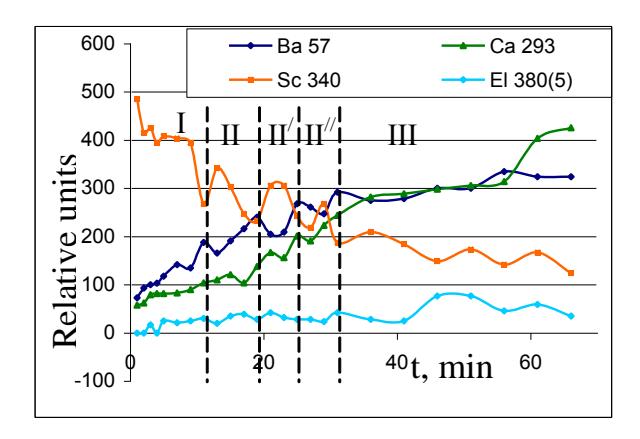
The experiment showed that scandium oxide surface loosening by barium atoms take place in first minutes of adsorbate sputtering. Our studies also confirmed the main role of calcium oxide molecules for the formation of crystallites on the basis of oxides of alkaline earth metals.
Binding energy of scandium oxide with Ba- and Ca- components differs: Ba- component has bigger thermal stability than Ca- component.
It helps to build a model of complicated structure grow on the scandium oxide surface in which Ba- component adsorbs with a Stranski-Krastanov mechanism and Ca- component adsorbs with a Volmer-Weber mechanism. Grow of Ba- islands and increase of Ca- cone volume depends on a ratio between their volume and surface diffusion coefficients.