
Laser refractive surgery using excimer ultraviolet (UV) laser was first performed on a human eye in 1990 by Pallikaris et al. [1] and applied in the clinics by Buratto and Ferrari [2]. Ever since, the corrective eye surgery was dominated by ArF excimer laser systems. They ensure an effective and predictable ablation since the absorbance of corneal tissue at ArF laser wavelength (193 nm) is high. However, excimer laser technology has several essential disadvantages. The active medium of the laser is toxic gas, the laser is maintenance-intensive and expensive, the system is sensitive for the environment conditions. The alternatives for the excimer laser in the refractive eye surgery have been actively researched for some time. Utilization of solid-state lasers is very promising since it guarantees stability and a good beam quality. Femtosecond lasers are becoming the routine tools in many ophthalmic procedures, for example, as the replacement of a microkeratome for flap creation in the LASIK surgery; in cataract surgery, corneal transplantation, presbyopia correction, etc. In this study we present a femtosecond all-solid-state system with capabilities of both deep UV laser source and standard IR femtosecond laser, as well as discuss results of the first in vivo applications.
A laser system for corneal ablation must meet several requirements. Firstly, energy density at wavelengths of corneal tissues absorption must be high enough for the effective ablation to be ensured. Secondly, the duration of the surgery has to be comparable to that when an excimer laser is used. Our deep UV laser system is based on femtosecond high power Yb:KGW laser "Pharos” (Light Conversion Ltd., Lithuania). When appended with the fifth harmonic generator, the laser provides $\sim 300$ fs, 206 nm pulses in a Gaussian beam. The efficiency of the fifth harmonic generator is about 7.7 %, and the output pulse energy is 11.5 μJ (230 mW at 20 kHz repetition rate).
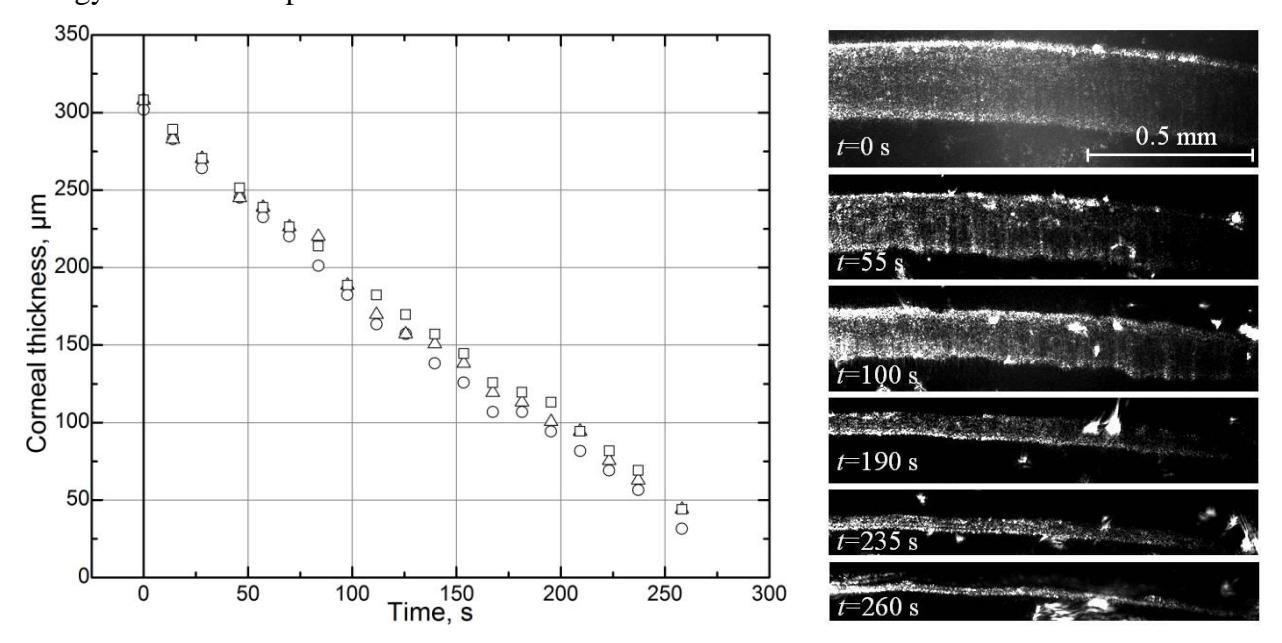
Our previous experiments using 206 nm 300 fs pulses gave excellent results of ablation on model materials such as poly(methyl-methacrylate), gelatin and freshly enucleated porcine eyes [3]. Here we present our first results of in vivo experiments on rabbit corneas. Corneas were mechanically debrided and received photoablation at an average power of 100-160 mW and repetition rate of 5-20 kHz with variable spot size. The duration of treatment for a 12 D refraction change within the optical zone of 6 mm was about 100 s with the laser duty cycle of 70%. Fig. 1 shows the progress of flat ablation of the cornea until perforation, performed at a 20 kHz repetition rate and an average laser power of 125 mW. From the cross sections one can see that the cornea keep its shape until it becomes very thin, which indicates gentle action of low energy femtosecond pulses.
In conclusion, the presented laser system has a potential of becoming a versatile ophthalmic laser system due to its high power and wide range of wavelengths. Further research is aimed towards investigation of the safety of short UV pulses, collection of more extensive statistical data is in progress.