
Perch is an important fish species in the Curonian Lagoon fishery as well as prey species in the diet of Great Cormorant (Phalacrocorax carbo sinensis). Fishermen often consider Cormorants as competitors and a necessity appears to evaluate how these two mortality factors interact with each other and affect perch population in the Curonian lagoon. Aiming to evaluate the interaction, age structure of perch population in the Curonian Lagoon was assessed. Fish were aged using otoliths collected in 2009 and 2010 (N=744). Otoliths have been processed by cutting and submerging into polyester resin on microscopes slides; annual rings were identified and counted using light microscope. Back-calculation was performed by measuring growth zones; different mean temperatures of the past growth seasons were used for age correction.
The obtained size-at-age data were used for estimation of growth and mortality parameters of perch population by employing FAO FISAT II software [1]. The analysis of length-at-age data showed an asymptotic total length (L∞) of 49.99 cm and growth curvature (K) of 0.13 yr-1.
The selectivity of Cormorants' diet and commercial 40 – 45 mm gillnet fishery was evaluated in 2009 and 2010. Cormorant diet was studied by analysing pellets (for detail description see [2]), collected at the Juodkrantė colony (N=560). Perch was one of the most important fish species by biomass and numbers contributing to the diet 19.7% and 18.7% respectively. Sets of various mesh size (14-17-21.5-25-30-33-38-45-50-70 mm) gillnets were used for fish sampling, perch length distribution and fishery selectivity evaluation.
Comparison of different cohorts in catches obtained as the result of the research surveys in 2009 and 2010 revealed that survival of 4, 5, 6-year old individuals was 53.4, 19.5 and 13 %, while instantaneous mortality rate (Z) was 0.27, 0.7 and 0.88 respectively. Increasing mortality rates from age group 4 did not fit with Cormorants' selectivity, which showed clear preference on 1 – 3 years old perch individuals (Fig. 1). In contrast to Cormorants' preferences, commercial 40 – 45 mm gillnet fishery targets and eliminates 4 – 6 years old perch.
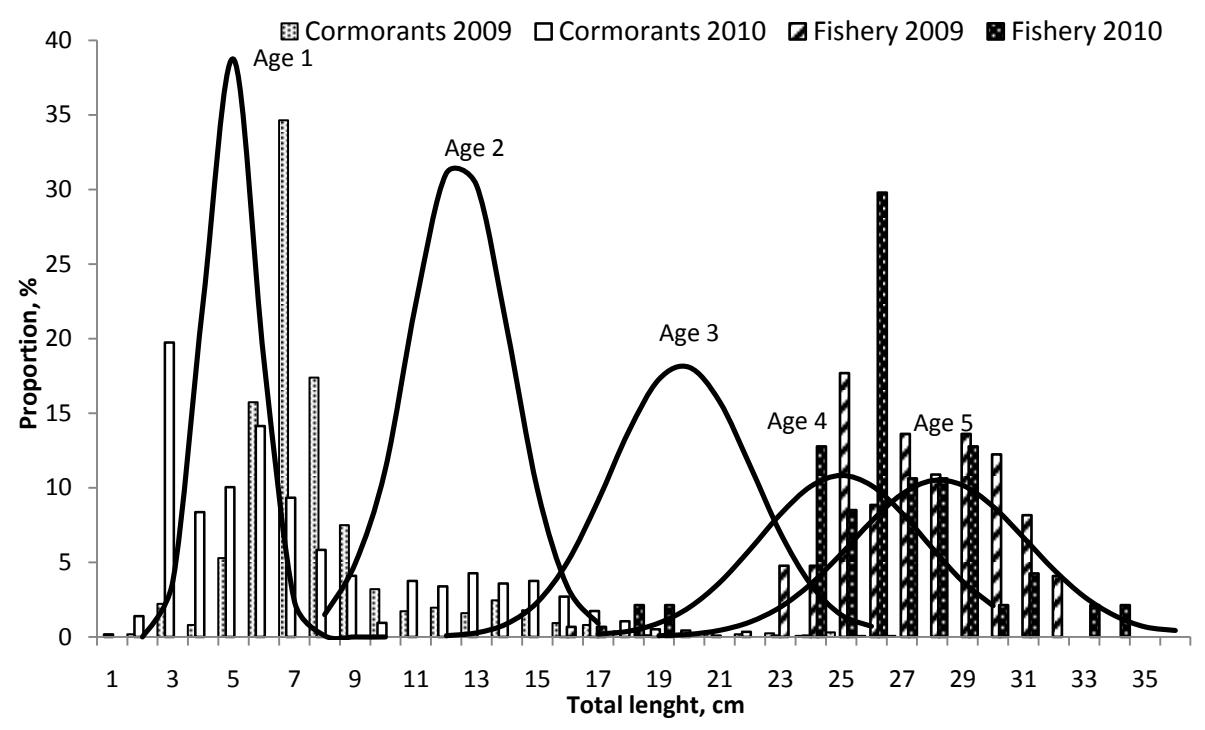
Our study demonstrates that direct competition between Cormorants and commercial fishery for perch stock is weak. On the other hand, Cormorants consume large amount of perch – approximately 140–160 tones in 2010 according to the diet study exceeding reported commercial landings by fivefold. However, Cormorants exploit young age, mostly premature perch and mortality caused by the predation might be compensated by lower intraspecific competition and reduced natural mortality caused by other factors. Evaluation of Cormorants' impact on perch stock needs further studies on the dynamics of fish cohorts, including such parameters as a recruitment and production.