LIGHT TWISTING WITH MICRO-SPHERES PRODUCED BY ULTRASHORT LIGHT PULSES
M. Beresna1, M. Gecevičius1, P.G. Kazansky1
1 Optoelectronics Research Centre, University of Southampton, Southampton SO17 1BJ, United Kingdom
Recently a property of light beams to carry angular momentum has attracted considerable attention due to numerous applications ranging from quantum optics1 to microscopy2 and micromanipulation3. Orbital angular momentum (OAM) is found in light beams with phase singularities which posses a nonzero azimuthal energy flow. Commonly used methods for generating beams with OAM are based on the exchange of orbital angular momentum with matter4. However, recently an efficient coupling of angular momentum carried by circular polarization with OAM was demonstrated in systems with the radial symmetry: second harmonic generation in laser induced plasma14, liquid crystal droplets13 and radially variant birefringent waveplates10, 11. Additionally, it was demonstrated that radial polarizer can introduce orbital angular momentum into the beam12. The advantage of this type process is that the helicity of the output wave front can be controlled by the handedness of incident light polarization. However, such systems could not be straightforwardly downsized, preventing from widespread application in integrated optics.
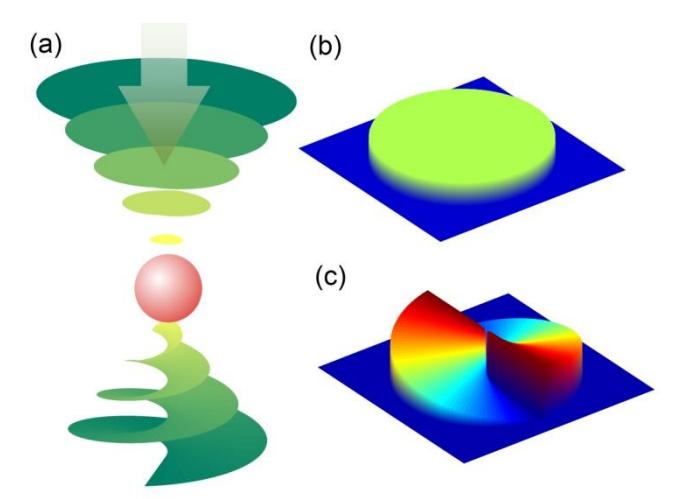
Fig. 1. (a) Optical vortex generation from an isotropic sphere. Incident circularly polarized light with plane front ($l$ = 0) after refraction on spherical surface is partially converted into optical vortex with orbital angular momentum $l$ = 2. (b, c) Modelled using Jones matrix formalism wave-front profiles of incident and transmitted electric field.
The system which could provide desirable compact form and also possess radial symmetry is a bubble or void. If the voids or bubbles embedded in glass have relatively high refractive index contrast, they exhibit edge birefringence17 related to differential transmission of $s$ and $p$-polarizations. In this letter, we propose and demonstrate radial polarizer based on a isotropic transparent sphere. As a result of angular momentum conservation, spherical interface leads also to optical vortex generation, which is directly observed on microscopic bubbles produced inside the glass by femtosecond laser.
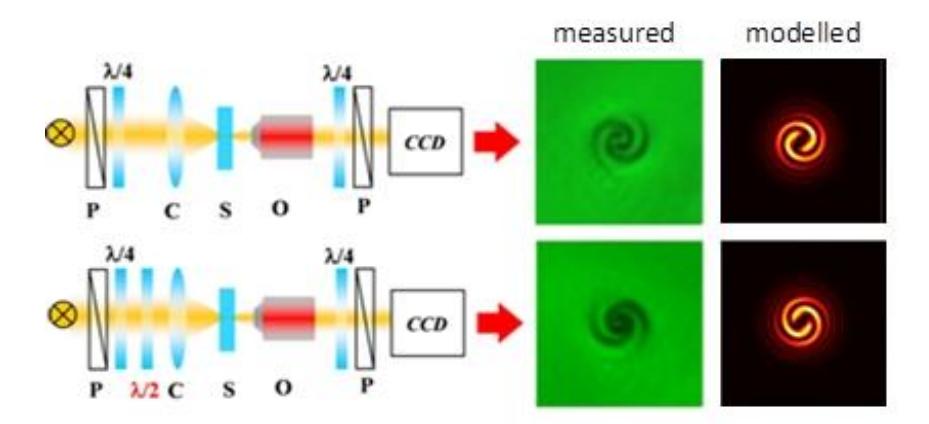
Fig. 2. Optical setups for optical vortex observation. P – polarizer, C – condenser, S – sample, O – objective. Vortex patterns (measured and modelled), observed under left and right handed polarizations, show mirror symmetry indicating reverse of orbital momentum sign.
We anticipate that the observed type of angular momentum interaction, localized in several microns and sensitive to the handedness of circular polarization, will open new opportunities in quantum optics, optical trapping and manipulation.
[1] K. Melcher, L.-M. Ng, E. Zhou et al., A gate-latch-lock mechanism for hormone signaling by abscisic acid receptors, Nature 462, 602-608 (1990).
[2] A. Mair, A. Vaziri, G. Weihs and A. Zeilinger, Entanglement of the orbital angular momentum states of photons, Nature 412, 313-316 (2001).
[3] O. G. Rodriguez-Herrera, D. Lara, K. Y. Bliokh, et al., Optical nanoprobing via spin-orbit interaction of light, Phys. Rev. Lett. 104, 253601 (2010).
[4] D. G. Grier, A revolution in optical manipulation, Nature 424, 810-816 (2003).
[5] L. Allen, M. W. Beijersbergen, R. J. C. Spreeuw and J. P. Woerdman, Orbital angular momentum of light and the transformation of Laguerre-Gaussian laser modes, Phys. Rev. A 45, 8185-8189 (1992).
[6] L. Marrucci, C. Manzo and D. Paparo, Optical spin-to-orbital angular momentum conversion in inhomogeneous anisotropic media, Phys. Rev. Lett. 96, 163905 (2006).
[7] J. A. Ferrari, W. Dultz, H. Schmitzer and E. Frins, Achromatic wavefront forming with space-variant polarizers: applications to phase singularities and light focusing, Phys. Rev. A. 76, 053815 (2007).
[8] E. Brasselet, N. Murazawa, H. Misawa and S. Juodkazis, Optical vortices from liquid crystal droplets, Phys. Rev. Lett. 103, 103903 (2009).
[9] M. Beresna, P. G. Kazansky, Y. Svirko, M. Barkauskas and R. Danielius, High average power second harmonic generation in air, Appl. Phys. Lett. 95, 121502 (2009).