
In regulation of the radio communication networks, it is necessary to evaluate the variation of the atmospheric radio refractive index, $n$, which is a ratio of the radio wave propagation velocities in free space and air. Changes of the atmospheric radio refractive index influence the path of the radio wave propagation. Therefore, quantitative knowledge of atmospheric refractivity variations is required in order to design reliable and efficient radio communication systems. The $n$-value is very close to the unit. Changes in this value are very small in time and space. On purpose to make those changes more visible, the term of radio refractivity, $N$, is used [1]:
$$N = (n - 1)\cdot 10^6 \tag{1}$$
The atmospheric radio refractive index (and refractivity as well) significantly depends on air temperature, pressure and relative humidity. These parameters vary according to the height from the Earth's ground, locality, season and diurnal time [2]. According to [3], for operating frequencies below 100 GHz, $N$ may be written as:
$$N = \frac{A(p + B \cdot p_{v}/T)}{T}\tag{2}$$
where $p$ is an atmospheric pressure (hPa), $p_{v}$ – water vapour partial pressure, $T$ – absolute temperature (K), $A = 77.6$ K/hPa, and $B = 4810$ K. Error is less than 0.5 %.
The ratio of $N$-value and height value (km) is called vertical radio refractivity gradient, $G$:
$$G = \frac{N_1 - N_2}{h_1 - h_2}\tag{3}$$
where $N_1$ and $N_2$ are the values of radio refractivity at heights $h_1$ and $h_2$, respectively.
It was concluded in [4], that the vertical radio refractivity gradient mostly depends on variations of humidity, and that influence of temperature variations is insignificant. In our previous paper [5], the peculiarities of the radio refractivity variations near the ground in time and location have been analyzed. In this work, using the meteorological data, which was measured in Vilnius, the values of vertical radio refractivity gradient were investigated in different heights from the Earth's surface, up to 1.2 km. The dependency of an average radio refractivity $N$ and its vertical gradient $G$ values (both $N$ and $G$ are average values of whole month on selected diurnal time) on the height above Earth's surface has been analyzed.
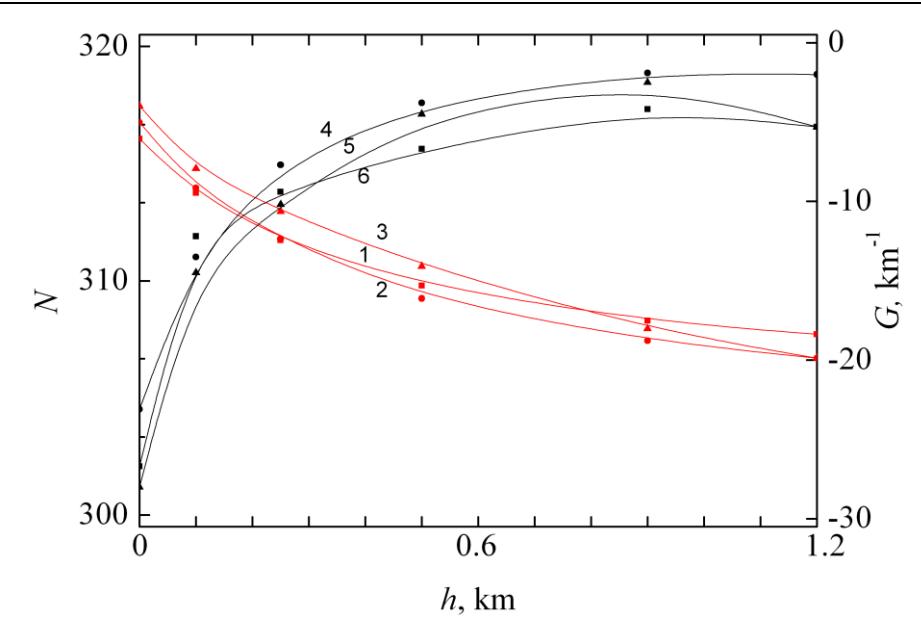
According to the results, $G$-values in October and November are higher than in December. The saturated vapour pressure varies in very narrow range when the temperature is significantly below 0°C. When temperature is slightly below, equal or above 0°C, the range is wider, and consequently the variations of saturated water vapour pressure are more noticeable. Consequently, the variations of $G$-values are considerable in October and November and quite trivial in December. In Fig. 1, the dependences of $N$ and $G$ on the height above the Earth's surface (in Vilnius, on 19 October 2010) are presented. The curves 1 and 4 correspond to the meteorological data measured on 6 AM; curves 2 and 5 - to 12 AM, and curves 3 and 6 – to 6 PM. The average daily temperature was about 4°C and the average relative humidity was about 93%.