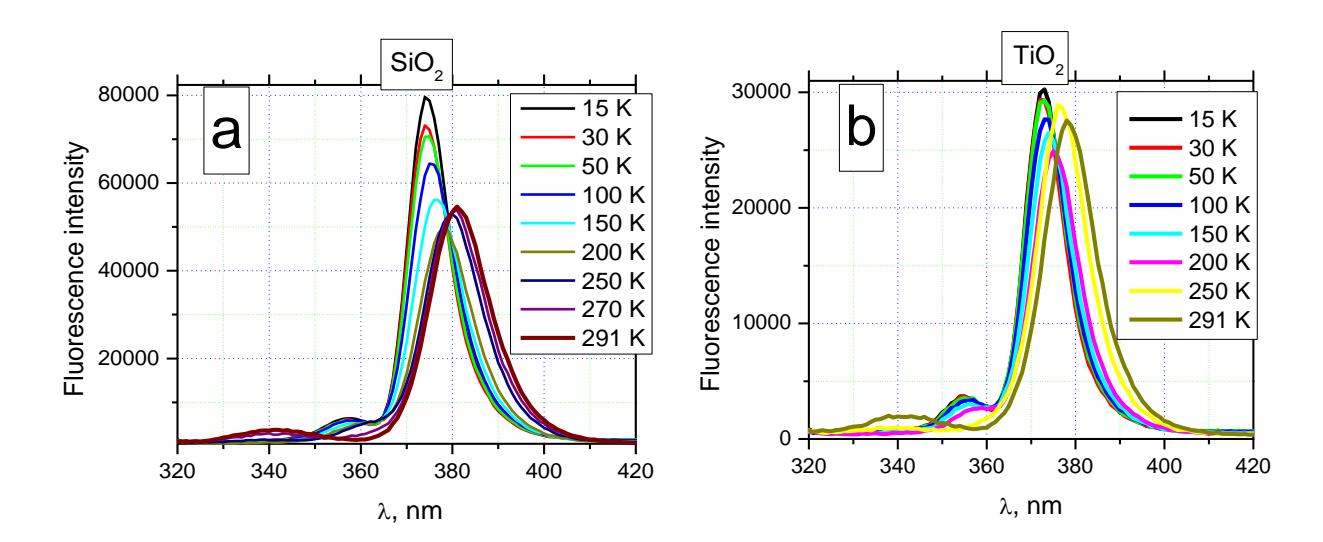
Potential application of nanosize polymers in different technologies such is transport and luminescent layers in electroluminescent diodes, sensors, and photoresistors stimulates investigation of their optical and electrical properties. Recently the possibility to manipulate properties of nanosize polysilanes by incorporating them in mesoporous silica has been demonstrated. It was shown that we can control the number of embedding polymer chains, their conformation and orientation, and their optical properties by simply changing diameter of nanopores. These investigations revealed new polymer conformational states with different degree of disordering, which are not present in polymer solutions and solid films [1, 2].
In this work four novel composite films based on photoconducting silicon-organic polymer poly(di-n-hexylsilane)-PDHS incorporated into different SiO2 and TiO2 nanostructures, namely in nanoporous SiO2 and TiO2 films, silica photonic crystals and silica gel, have been fabricated. Photoelectronic properties of these composites have been studied using photoluminescence (FL), absorption, FL excitation spectra as well as FL decay measurements in the wide temperature range (5-330) K. The analysis of the FL spectra of the composites shows three different polymer conformations coexisting inside a pore: gauche-, trans- conformation and aggregates. The aggregate fluorescence intensity in photonic crystal and in silica gel gradually decreases by increasing temperature, while in porous SiO2 and TiO2 films the temperature dependences are more complex: the fluorescence intensity gradually decreases by increasing temperature below trans-gauche transition, while at higher temperatures it increases until 310 K, when aggregates are thermally destroyed (Fig. 1).