
The beam propagation method (BPM) is an approximation technique for simulating the propagation of light in slowly varying optical waveguides. BPM has several key advantages. First, BPM is an effective method of modeling. Second, BPM is a quick and easy method of solving for fields in integrated optical devices. Third, BPM has also been extended to be applicable to analyze: polarization, nonlinearity, nonparaxiality, reflections and other physical phenomena.
Two coupled Fresnel equations in partial derivatives (3D geometry system) are used to describe first and second harmonic waves in 3D polymer layer with $\chi^2(x,y,z)$ micro-grating pattern:
$$2jk_0n_{\omega 0}\frac{\partial E_{\omega}}{\partial z} = \frac{\partial^2 E_{\omega}}{\partial x^2} + \frac{\partial^2 E_{\omega}}{\partial y^2} + k_0^2 \left(n_{\omega}^2(x, y, z) - n_{\omega 0}^2\right)E_{\omega} + k_0^2 \chi^{(2)*}(x, y, z)E_{2\omega}E_{\omega}^* e^{-j\Delta\beta z}\tag{1}$$$$4jk_{0}n_{2\omega 0}\frac{\partial E_{2\omega}}{\partial z} = \frac{\partial^{2} E_{2\omega}}{\partial x^{2}} + \frac{\partial^{2} E_{2\omega}}{\partial y^{2}} + 4k_{0}^{2}\left(n_{2\omega}^{2}(x, y, z) - n_{2\omega 0}^{2}\right)E_{2\omega} + k_{0}^{2}\chi^{(2)}(x, y, z)E_{\omega}E_{\omega}e^{j\Delta\beta z}\tag{2}$$where $k_0 = k_{\omega} = \frac{\omega}{c}$, $j = \sqrt{-1}$, $\Delta\beta = 2k_0(n_{2\omega 0} - n_{\omega 0})$ - phase matching mismatch (determines QPM grating period), $n_{\omega 0}$ and $n_{2\omega 0}$ are refractive indices of the first and second harmonic waves. Induced second-order nonlinear susceptibility is described as follows:
$$ \chi^{(2)}(x, y, z) = \chi_{eff}^{(2)}(x, y, z) \cos(\Delta \phi + \Delta kz) \exp\left(-\frac{\alpha_{2\omega}(x, y, z)}{2}z\right)\tag{3}$$where $\Delta \phi = \phi_{2\omega} - 2\phi_{\omega}$ - phase mismatch, $\alpha_{2\omega}$ second harmonic absorption coefficient and induced effective nonlinear susceptibility:
$$ \chi_{eff}^{(2)}(x, y, z) = \chi_{eff}^{(3)}(x, y, z) \operatorname{Re}(E_{\omega}^{2} E_{2\omega}^{*})\tag{4}$$Eq. (4) means that we have a generation of static electric field [1].
The above Eq. (1) and Eq. (2) system is so called BPM model of electromagnetic optical poling. Equations are solved by finite difference BPM [2, 3], using the Crank-Nicholson difference schemes with ADI (alternating direction implicit) algorithm. A transparent boundary condition (TBC) capable of handling wave propagation in the infinite space is incorporated in the finite difference algorithm.
3D optical poling results (first and second harmonic intensity distributions and induced $\chi^{(2)}$ distribution) are shown in Fig. 1, where $\chi^{(3)} = 1.8*10^{-23}$ m2/V2 . As shown in Fig. 1, we get depletion of first harmonic and localization effect of second harmonic and induced $\chi^{(2)}$ .
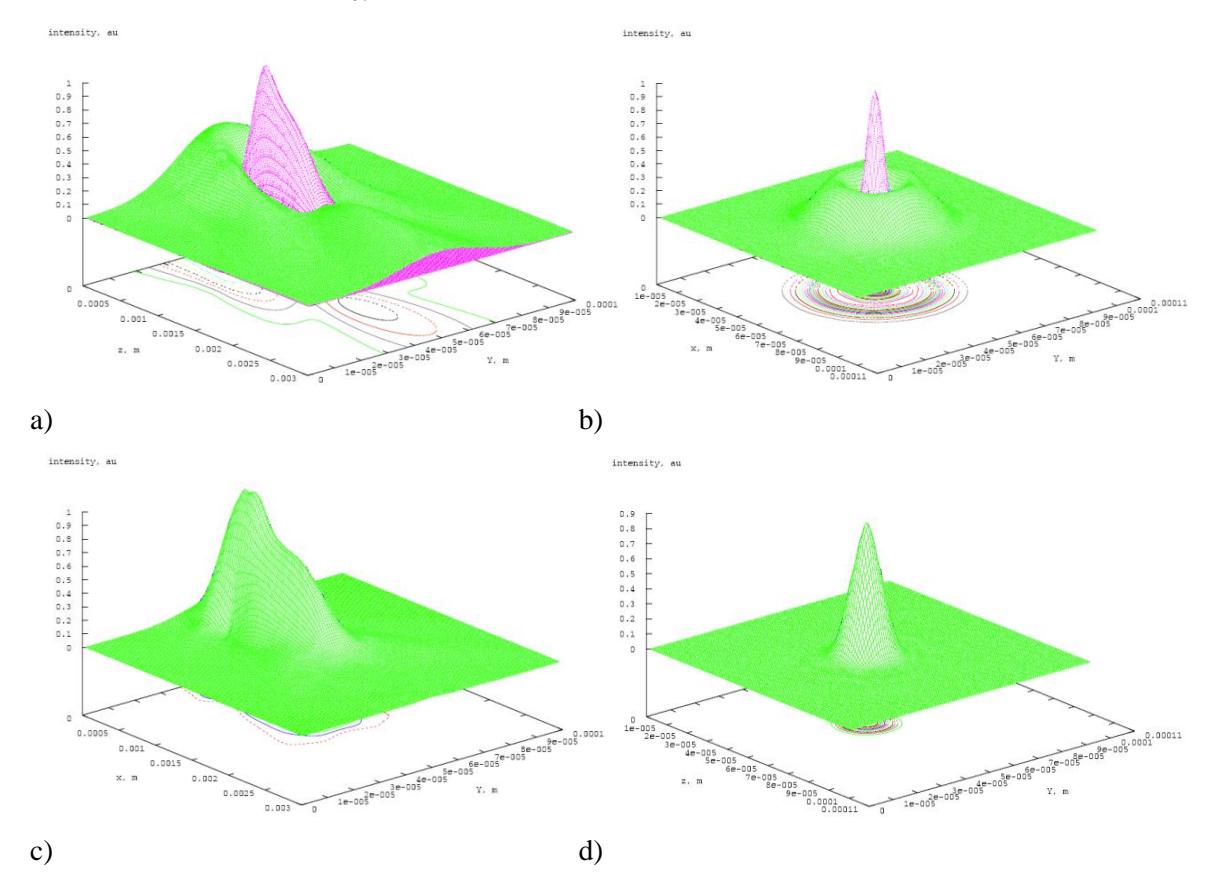
During this work 3D optical poling BPM model for focused polychromatic beams has been presented. This model also takes into account optical poling specifics related to the orientational hole burning mechanisms. Furthermore, it was shown that it is possible to achieve spatial localization of induced $\chi^{(2)}$ and depletion of first harmonic.