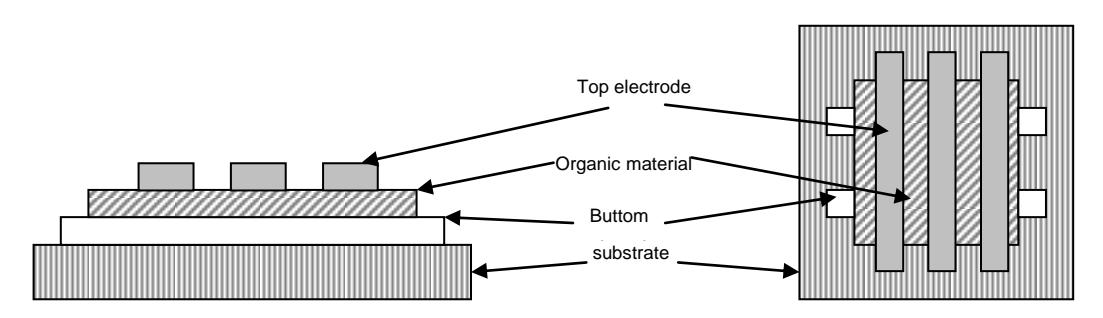
Modeling the organic light emitting diode structure, it is necessary to study electrical properties and energy structure of organic layer. Bi-polar organic material (electron and hole mobility is of same order) is very important for organic light emitting diodes (OLED). Carbazole derivatives are one of them.
In this work, we have studied electrical properties and energy structure of novel carbazole derivatives (JS97 and JS100) thin films. We used "sandwich" type samples (see Fig.1.) consisting of derivative of carbosole oligomer as an active layer sandwiched between top contacts of different metals and gold bottom contacts. The organic films were prepared by spin-coating method with the thickness of the order of 0.5μm and vacuum evaporating method with the thickness of order of 0.5 to 0.9 μm. It allows applying space charge limited current method to characterize charge carrier injection and energy distribution of traps in the thin films. For injection of holes ITO, Au, Pd, Cu electrodes and for injection of electrons Al electrodes were applied.