
Development and miniaturization in the field of electronic components has achieved the stage, when devices make use of quantum coherent effects. There are two actual development directions, namely, the design of new nanoscale digital electronics components and the development of new media and systems. Materials with anomalously high Fermi surface anisotropy are commonly referred to as one-dimensional ones. Their properties are described in terms of one or two dimensional zone structure, while the rest dimensions are spatially localized. It's evident, that transport characteristics of these systems are highly anisotropic, so while conductivity in chosen directions has typical metallic behavior, in localized dimensions we deal with jumps between layers, or even transport is denied. Analytical description of quantum transport on disordered wires in external electric field is discussed in [1]. Landauer approach is used there along with first approximation of controlling field with perturbation theory. In this paper we give numerical analysis of controlling electric field effect on one-dimensional chain represented with a curve. Also, we will consider the same system represented with narrow plain waveguide of finite length and the same shape as the above mentioned curve.
We give numerical analysis of controlling electric field effect on one-dimensional atom chain represented with a curve. Also, we will consider the same system represented with narrow plain waveguide of finite length and the same shape as the above mentioned curve. Curve shape is defined as $y(z) = a \exp(-\beta x^2)$, curve length is 30 nm and curve height $a$ is 2.4 nm.
In the first model we followed [2], where Kronig-Penney model with disorder is used to calculate conductivity. Then, as in [2,3], time-independent Schrodinger equation was represented as Poincare map due to the properties of scattering potential. It's known [4] that a distinguishing feature of one-dimensional models is abnormal conductivity fluctuation. We used uniformly-distributed random potential and a geometric mean of 100000 realizations for each point to cease fluctuations and make dispersion less than 10%. We applied longitudinal accelerating electric field with potential $U_x$= 0.01 – 0.1 eV and transverse controlling field $U_z$ of same strengths.
Due to the absence of non-coherent scattering in the system we observed nonlinear, almost exponential transparency dependencies on both fields intensities. The dependence of transparency versus field intensity can render a possible use in high-frequency switches. However the considered system is rather simplified. That's why we also consider a a plain channel of finite width.
The second model represents a nanoscale curved channel (quantum waveguide) of a finite width and previously defined shape with one electron passing through. We used Split-Step Fourier (SSF) method [5], a simplectic integrator of error $O(dt^3)$ on a step. High amount of calculations requires supercomputer usage. Supercomputer implementation of SSF is described in [6,7]. We simulated the same modes as in the first model and compared the results (fig. 1). One can see that transparency in both models can be controlled by transverse field.
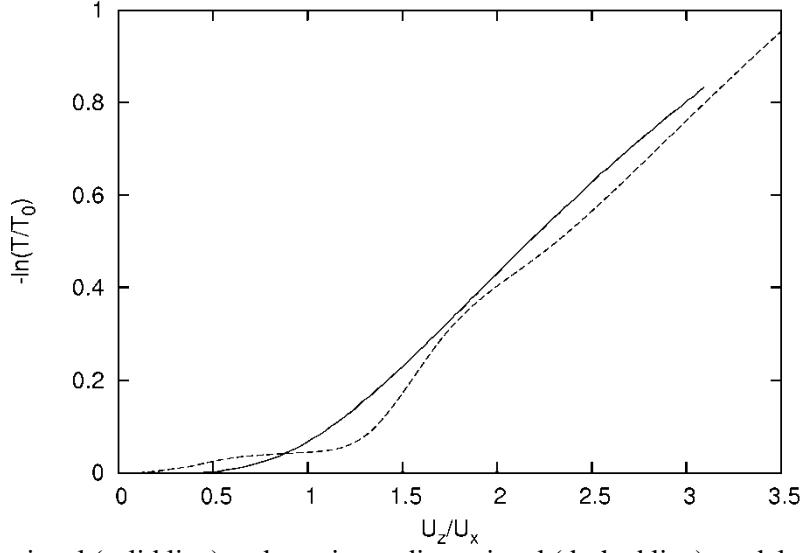
We have demonstrated the existence of field control in one-dimensional and quasi-one-dimensional systems. Fields of relatively small intensities can be used to control conductivity of these systems in coherent quantum transport mode. Localization phenomena become exponentially sensitive to the field magnitude. Both considered models have given qualitatively compliant results.