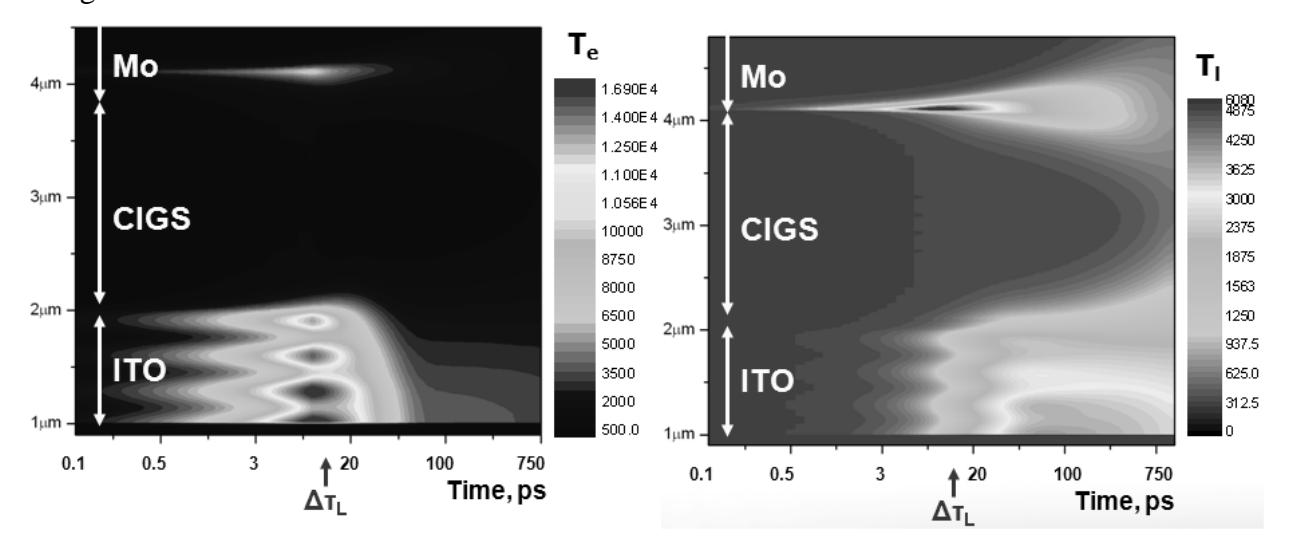
A permanent growth of the thin-film electronics market stimulates the development of versatile technologies of patterning thin-film materials on flexible substrates. Selective ablation is one of the most important parts of these processes therefore deeper understanding of underlying physical phenomena is required for further development of the technology.
Structure under consideration is layered medium consisting of thick polymer substrate at the bottom, 1μm molybdene layer 2μm CIGS layer, 50nm CdS and 50nm ZnO and a 500nm layer of ITO on top of the solar cell. Material is irradiated by laser from ITO side. Modeling consists of three parts: energy coupling calculation taking into account interference effects, two-temperature model for heat calculation and phase transition considerations.
Energy coupling modeling is carried out in the following way. We consider 2D geometry of solar cell layers in which harmonic TE waves propagate according to wave equation:
$$\nabla \times (\nabla \times \mathbf{E}) - n^2 k_0^2 \mathbf{E} = 0 \tag{1}$$Where $n = n_0 + jk$ is a complex refractive index. Due to boundary conditions between two adjacent layers multiple reflections occur. In some cases energy coupling profile in the material deviates from its' usual exponential decay form significantly. Floquet boundary conditions must be set on exterior boundaries of 2D domain to simulate plane wave propagation.
Diffusion equation is required in this model. Due to apparent extremely high temperatures and fast absorption when imaginary refractive index part is significant, two-temperature model must be used:
$$C_e \frac{\partial T_e}{\partial t} = \nabla \cdot (K_e \nabla T_e) - G(T_e - T_l) + S(\mathbf{r},t) \tag{2}$$$$C_l \frac{\partial T_l}{\partial t} = \nabla \cdot (K_l \nabla T_l) + G(T_e - T_l) \tag{3}$$These equations physically mean that electrons and lattice are separate physical systems and for each a separate diffusion equation is in operation. Electrons are first to absorb laser energy, only then with the help of electron-lattice coupling term $G(T_e - T_l)$ electron system transfers energy to lattice. $S(\mathbf{r},t)$ term corresponds to energy coupling from the first part of the modeling.
Since achieved lattice temperatures surpass those required to heat it up to a melting point, a phase transition had to be included in the model. Advantage was taken of Gaussian function which was added to specific heat expression:
$$C_l^{ph} = C_l + \frac{L}{\sqrt{2\pi}\sigma} e^{-\frac{(T_l - T_0)^2}{\sigma^2}} \tag{4}$$Where $L$ corresponds to latent heat, $T_0$ - melting temperature and $\sigma$ is a numerical stability parameter, which was chosen to be approximately 1-2% of the maximum lattice temperature. Analogous term was added for evaporation processes if necessary.
A typical modeling result (the picture is deprived of phase transition effects) is represented in Figure 1.