
Efficiency of thin-film CuInxGa(1-x)Se2 (CIGS) solar cells with large active area might be maintained if small segments are interconnected in series in order to reduce photocurrent and resistance losses [1]. Theoretical CIGS element efficiency limit reaches 27% [2] with a record value of 20.3% [3] which was demonstrated in laboratory conditions. Cell interconnect formation requires high quality scribing with precise depth control. Laser ablation has been established as one of the most effective method of solar cell element microfabrication method [4]. Scribing the thin-film solar cells with Gaussian beam profile causes damage in the center of laser machined trench and excessive melt formation at the trench edges. To avoid damage and melt formation it is necessary to convert it to a more suitable profile beam [1].
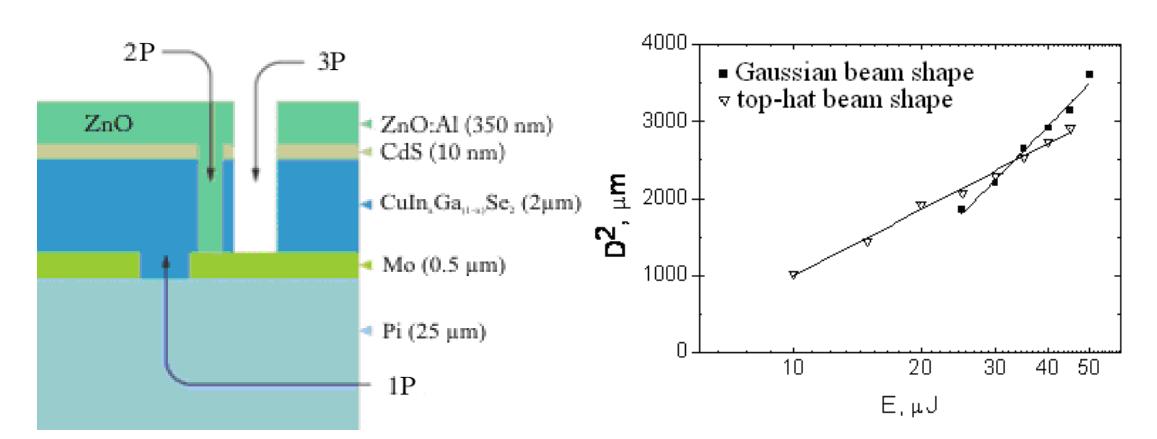
The aim of this research was a laser beam profile formation with top-hat laser beam shaper and photovoltaic thin-film processing mode selection in order to maximize the quality and productivity of thin-film laser scribing. The photovoltaic elements used in experiments where complete multilayer thin-film solar cell structures made of ZnO/CdS/CIGS/Mo/Pi layers (Fig. 1). Laser with picosecond pulse duration (10ps), 100 kHz rate and 1064 nm wavelength together with laser beam profile shaper were used in the experiments. In this work, P3 scribing process was studied to expose the Mo back-contact layer. Relationship between the ablated crater area and laser pulse energy is shown in Figure 2. The experiment shows that the laser beam profile has flattened when top-hat laser beam shaper was used.
High quality P3 type scribes in CIGS solar cells using top-hat beam profile were achieved with 500mm/s scanning speed, 5 scans and 0,63 W laser power. Uniform exposure of Mo back-contact was observed with small melted areas at the edges. Using Gaussian beam profile laser scribes were achieved with 500mm/s scanning speed, 3 scans and 0,6 W laser power. In order to maintain damage-free molibdenium back contact less scans were performed, however, wider melt formation areas were observed at the edges.
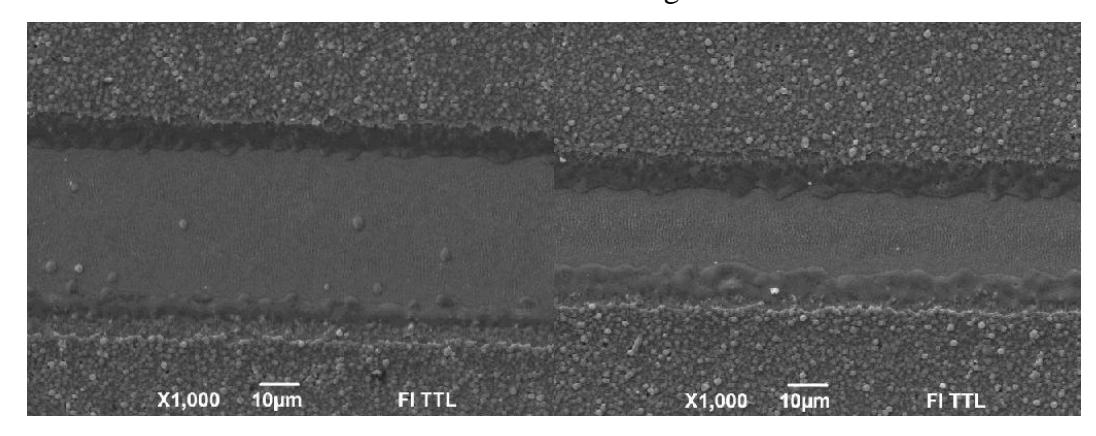
Top-hat laser beam profile increased productivity of thin-film solar cells scribing and has led to greater ablation quality, therefore it has great potential in the roll-to-roll production applications.