
In 2009 Estonia approved the National Development Plan for the Energy Sector, including the nuclear energy option. This can be realized by construction of a nuclear power plant (NPP) in Estonia or by participation in neighboring nuclear projects (e.g., Lithuania and/or Finland). Either option requires the availability of competent personnel. It is necessary to prepare specialists with expertise in all aspects related to nuclear infrastructure and to meet workforce needs (e.g. energy enterprises, public agencies, municipalities). Estonia's leading institutions of higher education and research with the support of the European Social Fund have announced in this context a new nuclear master's curriculum to be launched in September 2011. The language of instruction will be English.
Since April 2009 a committee at the University of Tartu (UT) has been working with partners at Tallinn University of Technology (TUT) to develop and introduce the completely new joint master's program “Nuclear Energetics and Nuclear Safety.” The committee members include: Alan H. Tkaczyk, Arvo Kikas, Enn Realo, Marco Kirm, Madis Kiisk, Kadri Isakar, Siiri Suursoo, Rein Koch, Eduard Feldbach, Aleksandr Lushchik, and Kaido Reivelt. This new degree curriculum complies with the European Atomic Energy Community (EURATOM) treaty and takes into account International Atomic Energy Agency (IAEA) and European Nuclear Education Network (ENEN) recommendations. It is based on consultations with the premier Estonian energy company Eesti Energia, the Environmental Board Radiation Department, and international scientific contacts.
The curriculum consists of the following modules:
1) General subjects module which provides students the basic knowledge on nuclear physics and technology.
2) Nuclear energetics module providing a theoretical and applied fundamental knowledge of nuclear fuel cycle. This module includes hands-on nuclear reactor training.
3) Nuclear safety module which handles nuclear and radiation safety, including radiological assessment.
4) Electives for quality management, economics, measurements, reactor dynamics and practical experience.
5) Free electives to broaden horizons or complement specialized knowledge according to needs and interests.
6) Master's seminar including literature reviews, oral presentations, and excursions.
7) Master's thesis, which develops knowledge and skills related to independent research in the specialty.
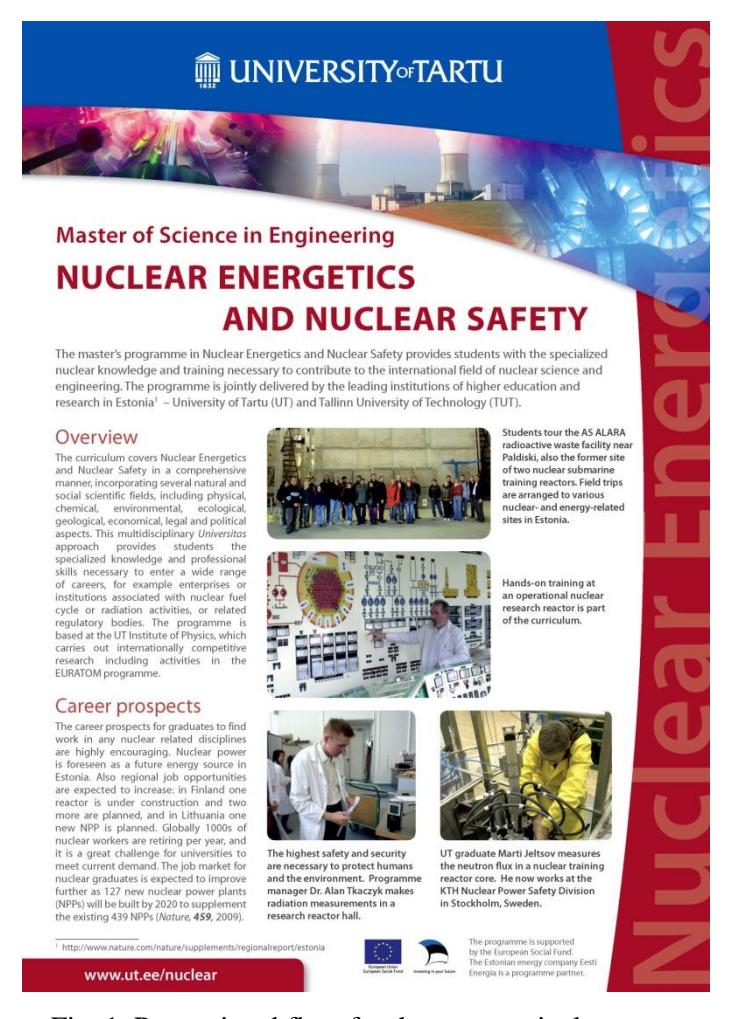
Upon completion of the curriculum the graduate is expected to have systematic knowledge of the physical and chemical basis of nuclear energetics and the technologies used in nuclear power plants; has acquired an overview of the management of nuclear safety and emergency preparedness; understands nuclear safety assessment methods, international nuclear regulatory requirements on construction, operation, monitoring and control; understands nuclear safety culture and safety requirements; is able to assess risks associated with nuclear energetics; has expertise in measuring ionizing radiations and doses, analyzing measurement results, and assessing radiological impacts; is able to participate and defend his/her scientific views in discussions related to the profession, and communicate with both specialists and non-specialists; is competent to be employed in the nuclear field, or to pursue doctoral studies. Students from all countries are encouraged to apply to the program at the website www.ut.ee/nuclear and there are some scholarships available.