
Optical parametric generation (OPG) is a promising method for development of tunable light sources [1, 2]. These light sources in 2.7 – 3.1 μm spectral range could be useful for analyzing properties of the water rich biological objects, which are characterized by high absorption in this spectral range. It is also important to generate at this wavelength femtosecond pulses with sufficient power for laser micromachining of those biological tissues.

The experimental setup (Fig. 1) consist of Pharos laser (Yb:KGW) producing 290 fs pulses at 100 kHz repetition rate at 1026 nm wavelength. We used a 8 mm long and 0.5 mm thick periodically poled lithium niobate (PPLN) structure with 27 gratings, whose periods varied in 0.25 μm step from 25 μm to 31.5 μm. For the generation of the idler wave in 2.7 – 3.1 μm spectral range we used grating with 29.5 μm period. The crystal was heated to 120°C temperature in the copper oven in order to minimize a photorefractive effect.
First of all, the optical damage threshold of the PPLN crystal was found out by taking the measurements of the laser beam diameter on the crystal and energy, which caused surface damage. Measurements showed that damage threshold for S on 1 test with S=106 pulses with 290 fs duration at repetition rate 100 kHz was 0.02 J/cm2.
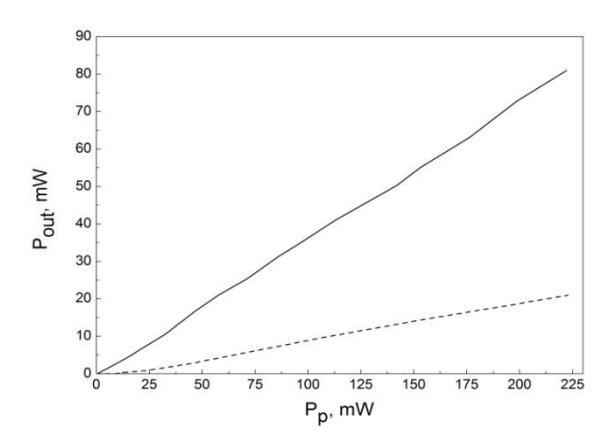
The experimental setup for analysis of the OPG's power characteristics is shown on Fig. 1. Output and pumping power was measured by Ophir Optronics thermal power sensor. Furthermore, two mirrors with high reflection index (~99.6%) for pumping wavelength ($\lambda$= 1.026 μm) were used. Selective filters for required wavelengths were chosen depending which conversion efficiency was measured. Selective filter IKS-5 was used in conversion efficiency to signal power measurements and the filters SZS – 21 and SZS – 25 were used for conversion efficiency to the second harmonic (SHG) (513 nm) measurements. Results are shown in Fig. 2.
Measured threshold pump intensity for parametric generation was equal to 2.77 GW/cm2 using the 8 mm long PPLN structure. The conversion efficiency from pumping (1026 nm) to signal (1535 nm) was 11 % when 23 GW/cm2 pumping intensity was reached. Conversion efficiency into SHG was measured 36% when 12.5 GW/cm2 pumping intensity was reached. Measured data shows, that quite low optical parametric generation efficiency was caused by a competitive process of SHG, which brought away large part of pumping energy.
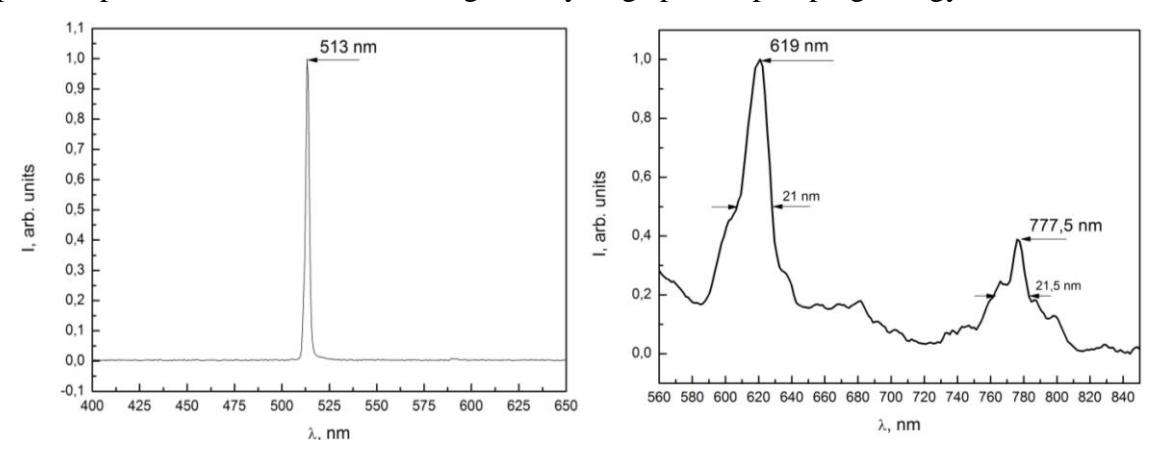
Output parameters of the OPG radiation were measured using Avantes spectograph, with registration range from 200 nm to 1100 nm, i.e. that was too narrow to observe radiation of OPG directly. Recorded spectral distribution is shown in Fig. 3, where spectral line at 619 nm corresponds to the sum frequency generation of signal and pumping pulses, 777,5 nm corresponds to the signal wave's second harmonic and 513 nm corresponds to the SHG of pumping wave.