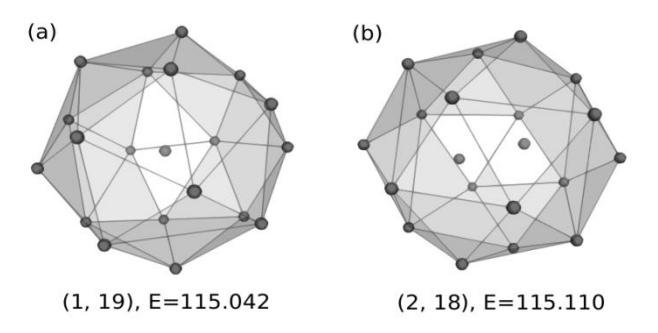
Strongly interacting systems of classical charged particles confined in traps are known to form regular structures, known as Wigner clusters. Typical experimental realizations of such systems include electrons on the surface of liquid helium and micro-metric charged dust particles in low-temperature complex plasmas [1]. It turns out that in most cases besides the unique ground-state configuration, corresponding to the global minimum of the potential energy, a number of metastable states corresponding to various local minima are present (Fig. 1). The number of stable states grows very rapidly with the number of particles and reaches hundreds already for moderate systems containing only several tens of particles. Different stable states are typically realized with very different probabilities and often the ground-state configuration is not the most probable one [2].
In the present work we present a theoretical study of classical Wigner clusters in two- and three-dimensional isotropic parabolic traps aiming at understanding and quantifying the configurational uncertainty due to the presence of multiple stable configurations. Employing the computational procedure based on Monte Carlo and downhill minimization techniques, we investigate the cases of both Coulomb and Yukawa inter-particle interactions in the systems of up to $N$=100 particles. We show, that the total number of metastable configurations is ill-defined and not a representative quantity for large clusters. Instead, following the definitions accepted in information theory [3], we propose to rely on the concept of *configurational entropy* and investigate its dependence on the system size, dimensionality and screening.
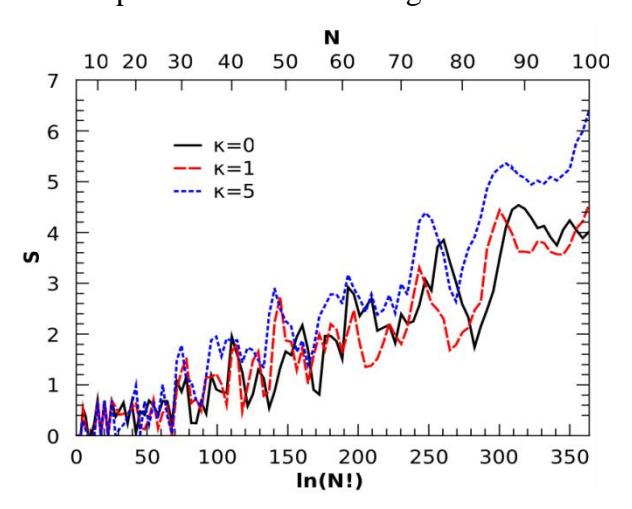
Configurational entropy could be understood as the expected value of the logarithm of state probability, or as the logarithm of the *effective number of states* [4]. It is a robust and objective measure of uncertainty, insensitive to the presence of overlooked low-probability states and can be reliably determined even within the limited time of the experiment or a simulation. It turns out, that the effective number of stable states grows faster than exponentially. That is, on the average, the entropy grows as the logarithm of the factorial of $N$ (Fig. 2). The entropy grows faster in systems with short inter-particle interaction range.